
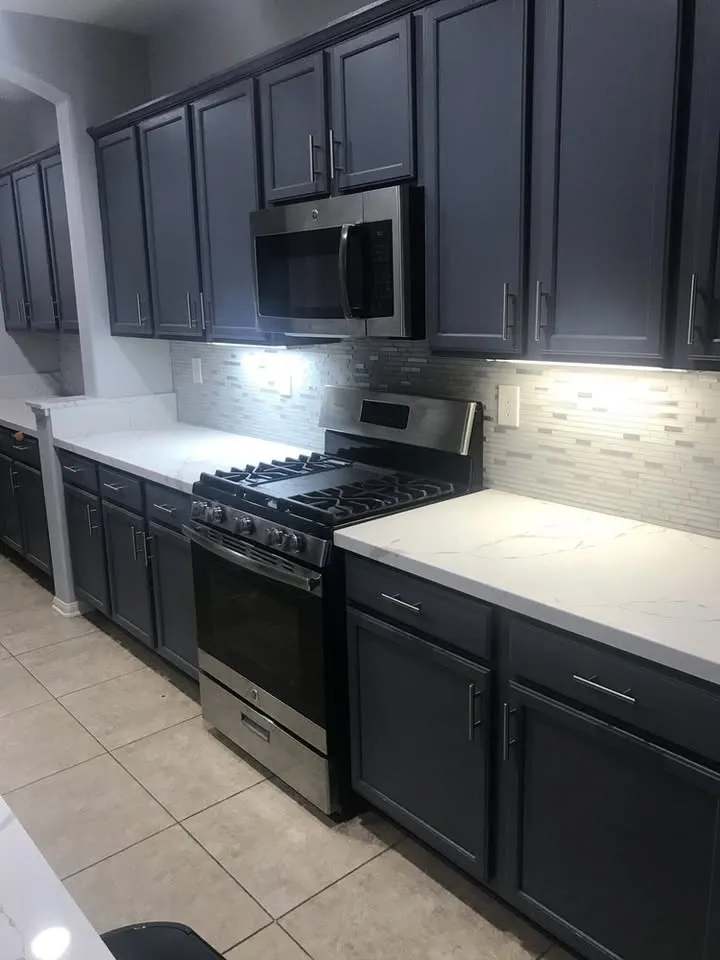
If you’re considering cabinet refinishing in Temecula or anywhere in Temecula Valley, one of the most important decisions isn’t the color. It’s the coating system your painter uses — and it’s worth asking about before you commit.
Parallel Painting’s cabinet-finishing process uses a two-component (2K) polyurethane system.
I’ve been refinishing cabinets professionally for years. Here’s what you need to know before you commit, and the questions worth asking any contractor you’re considering.
What Is 2K Polyurethane?
“2K” refers to the two-component (2K) polyurethane system name. Parallel Painting’s cabinet-finishing process uses a two-component (2K) polyurethane system.
How to Compare Coating Options
When you’re evaluating cabinet refinishing quotes, the coating is one of the things worth pinning down in writing. Rather than relying on a service label, ask each contractor for the specifics.
Ask for the Exact Product
Ask for the exact coating product and current technical documents. A specific product name and an up-to-date technical data sheet tell you far more than a category label. Compare written scopes rather than relying only on service labels.
Ask How It’s Prepared and Applied
Ask each contractor for the exact preparation steps. A coating is only as good as the prep underneath it and the way it’s applied.
Confirm what is removed, repaired, masked, coated, cured, and reinstalled. A written scope that spells out each of those steps is easier to compare than a verbal promise.
Heat, Moisture, and Daily Contact
Kitchens are demanding environments. Surfaces near cooktops, ovens, and dishwashers face heat; sinks and dishwashers add steam and splashes; and grip edges see constant contact. No finish is immune to wear, so ask each contractor how their product and process are suited to those conditions, and ask to review the product’s current technical data sheet.
Application Method
Parallel Painting uses spray application for its cabinet-finishing process. Other manufacturer-approved cabinet products may permit brush, roller, or spray application.
When you compare quotes, confirm in writing how each contractor plans to apply the coating and what containment they use. What matters to you is the finished result and how long it lasts.
The Cost Difference
Quotes vary, and the coating is one of several factors that move the number. Our cabinet refinishing starts with an in-home count of doors and drawer fronts, then a written quote after Tyler checks the kitchen in person. Pricing depends on the scope of your specific kitchen, so the honest answer comes from seeing it.
The material and labor differences across quotes are real. Ask each contractor for the exact coating product and current technical documents, and compare written scopes rather than relying only on service labels.
But there’s a long-game point worth keeping in mind. The durability of a finish — not just its upfront price — determines its real value over the years you own the cabinets. A finish that lasts and a finish that has to be redone aren’t the same purchase, even if the first invoice looks cheaper. For how scope drives the number, see the cabinet refinishing cost guide.
My Recommendation
I use 2K polyurethane on every cabinet project, sprayed over real prep. It’s a two-component catalyzed finish that chemically cures into a hard, tough shell instead of just drying like paint, and I’ll show you the exact product and its data sheet at the estimate. Every project comes with a written five-year warranty: if the finish chips, peels, or blisters because of faulty prep, I come back and repair it.
If you’re comparing quotes for cabinet refinishing, ask every contractor for the exact coating product and current technical documents, and ask for the exact preparation steps. Compare written scopes rather than relying only on service labels — that’s the clearest way to know what you’re getting.
Want to learn more about the 2K finish we use? Read our detailed breakdown on what 2K polyurethane is and how it works. Or if you’re ready to see what it would look like in your kitchen, get your free estimate — I’ll come to your home and walk you through the process in person.
Serving Temecula, Murrieta, Menifee, and the greater Temecula Valley area.