


Sprayed 2K
Cabinet Refinishing Cost in Temecula
A smooth sprayed finish. A kitchen you're proud to show off.
- Yelp: 56 reviews, 4.8-star rating
- Google: 10 reviews, 5.0-star rating
5-Year Written Warranty
The written 5-year warranty covers chipping, peeling or blistering caused by faulty preparation. The coating itself is covered by its manufacturer.
- CSLB #1015608
See and feel finish samples in your own kitchen.
Standard single-color exterior cabinet refinishing commonly runs about $135–$185 per cabinet door and $95–$145 per drawer front before project-specific adjustments.
2026 Pricing Guide: Temecula & Murrieta
How Much Does Cabinet Painting or Refinishing Cost in Temecula and Murrieta?
How Temecula cabinet refinishing is priced
Standard single-color exterior cabinet refinishing commonly runs about $135–$185 per cabinet door and $95–$145 per drawer front before project-specific adjustments.
Door and drawer count varies widely — from around 16 in a small kitchen to 60+ in a large kitchen with an island and extensive cabinetry — and that range alone creates a 3x cost difference before accounting for anything else.
Here's what actually moves the price, and how Tyler writes one fixed quote after counting your kitchen in person. The same planning ranges apply in Temecula, Murrieta, and the rest of the Temecula Valley. The in-home estimate confirms the cabinet condition and project scope.
Or call (951) 551-0583
Tyler brings a sample to your home and gives a fixed written quote after looking over the cabinets in person.
This is Southern California planning guidance — not a price list.
Each rate is per one physical cabinet door or drawer front — not per cabinet box.
These planning ranges include the standard exterior work on your cabinets: door fronts and backs, drawer fronts, face frames, box exteriors, toe kicks, and side panels. They also include removal and reinstall, preparation, 2K polyurethane, HEPA-vacuumed sanding, sealed negative-pressure containment, and the 5-year written warranty. Tyler Fowler handles each project personally. Oak grain remains visible unless you choose grain filling.
What moves the price
Three things set the price:
Doors and drawer fronts: the per-piece range above, with the cabinet boxes, face frames, toe kicks, and side panels included.
Grain filling: adds about $30–$85 per cabinet door and $10–$20 per drawer front, depending on how deep the grain is and whether the backs of the doors are filled too.
Painted interiors: add about $35–$60 per cabinet door and $25–$45 per drawer front on average, depending on how many cabinets there are and the condition of the insides. Some interiors are prefinished and fine as they are.
Small kitchens cost more per door, because the same sealed, negative-pressure work area still has to be built around them; failing old finishes, heavy damage, extra colors, repairs and specialty finishes also add to the price. A fan draws air through a regular filter and vents outdoors to help control airborne dust, overspray, and fumes within the work area.
Tyler provides a fixed written quote after counting your doors and drawer fronts and looking over the cabinets in person.
For a full kitchen, the door and drawer-front count is the starting point.
| Option | What it covers | Planning range |
|---|---|---|
| Cabinet door | Front and back painted; cabinet boxes, face frames, toe kicks, and side panels included | $135–$185 per cabinet door |
| Drawer front | Painted; same inclusions as the door | $95–$145 per drawer front |
| Grain filling (optional) | Light for shallow grain or heavy for deep grain such as red oak; door fronts only, or fronts and backs | adds $30–$85 per cabinet door; $10–$20 per drawer front |
| Painted interiors (optional) | The inside of the cabinet boxes, cleaned and sprayed; an average, since it depends on how many boxes there are and their condition | adds $35–$60 per cabinet door; $25–$45 per drawer front |
Or call (951) 551-0583
Tyler or Melissa will reply to set up a visit. Tyler brings a sample to your home and gives a fixed written quote after looking over the cabinets in person.
Grain filling on frames and panels is quoted separately. Filling follows an approved cured sample. Heavy oak comes out smooth to the touch with the pores filled, but it is still real wood: under bright side light you will see gentle waves from the grain, not the dead-flat look of MDF.
Painted interiors are counted per cabinet box; corner, lazy-susan, sink, and extra-wide boxes take more.
A sound factory interior can be cleaned and sprayed. Damaged, peeling, or heavily greasy interiors need extra preparation and bonding primer.
Interiors are not grain-filled unless you request that separate work and approve a cured sample.
If you want a completely flat, MDF-style door on heavy oak, new doors are supplied and installed by a licensed cabinet partner. Parallel Painting finishes the new doors in the same 2K and refinishes the existing boxes to match; its painting license does not cover supplying or installing doors.
Pricing guidance last verified October 24, 2026.
See the finish up close · 0:12
The Finished Result
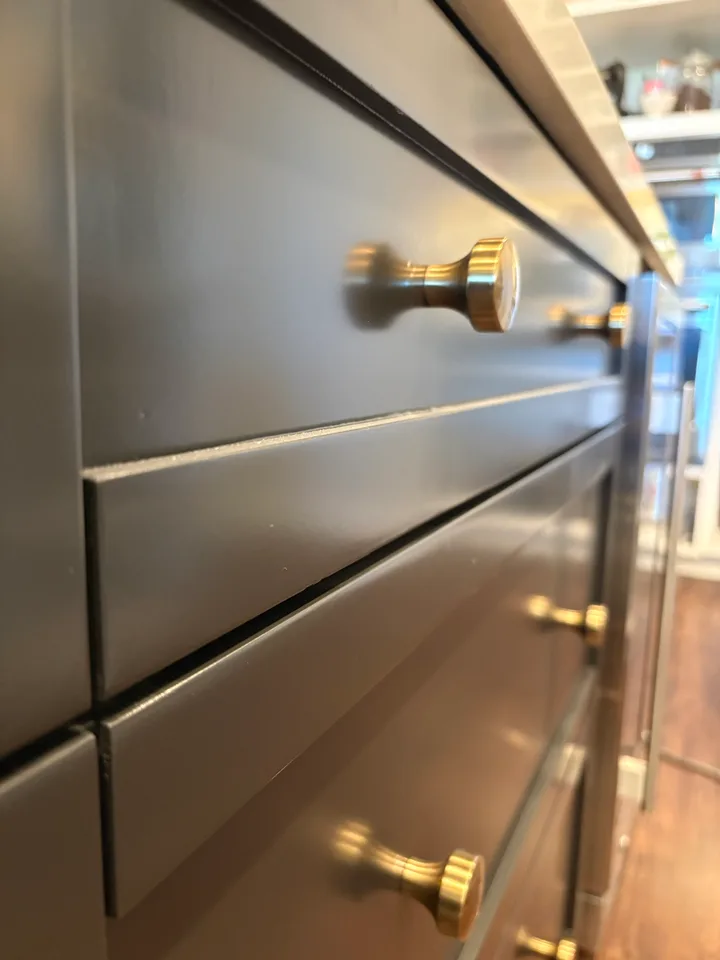
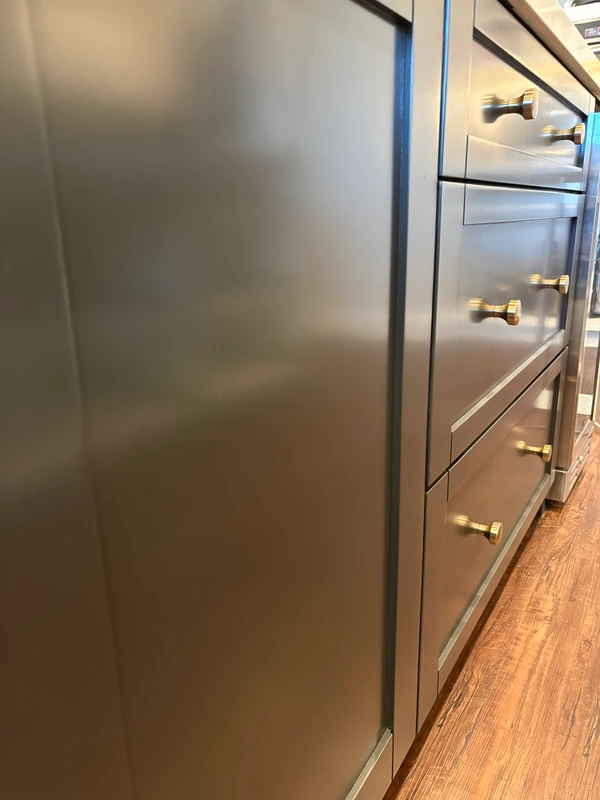
A black kitchen island in Temecula, prepared and sprayed in 2K polyurethane by Tyler.
Tap play to inspect the finish. 0:12 · No sound.
Watch a black kitchen island refinished in Temecula (0:12)
What goes into that finish
The work behind the finish.
The time is in the preparation, surface corrections, sanding and sprayed coating system. These are photos from Tyler’s process.

Protect & clean
Remove and label the doors. Mask the kitchen, degrease and prepare the surfaces.
Prime & correct
The longest step. Two primer coats. Between them, every surface is skim-coated with glazing putty, dents and seams are spot-puttied, and it is all sanded smooth. Every surface is checked under bright inspection lights before the topcoat. Optional grain filling.
Sand smooth
Sand the corrections, primer and between topcoats. Each coat needs drying time.
Spray & reinstall
Spray two to three 2K topcoats. Reinstall and align the doors once ready.
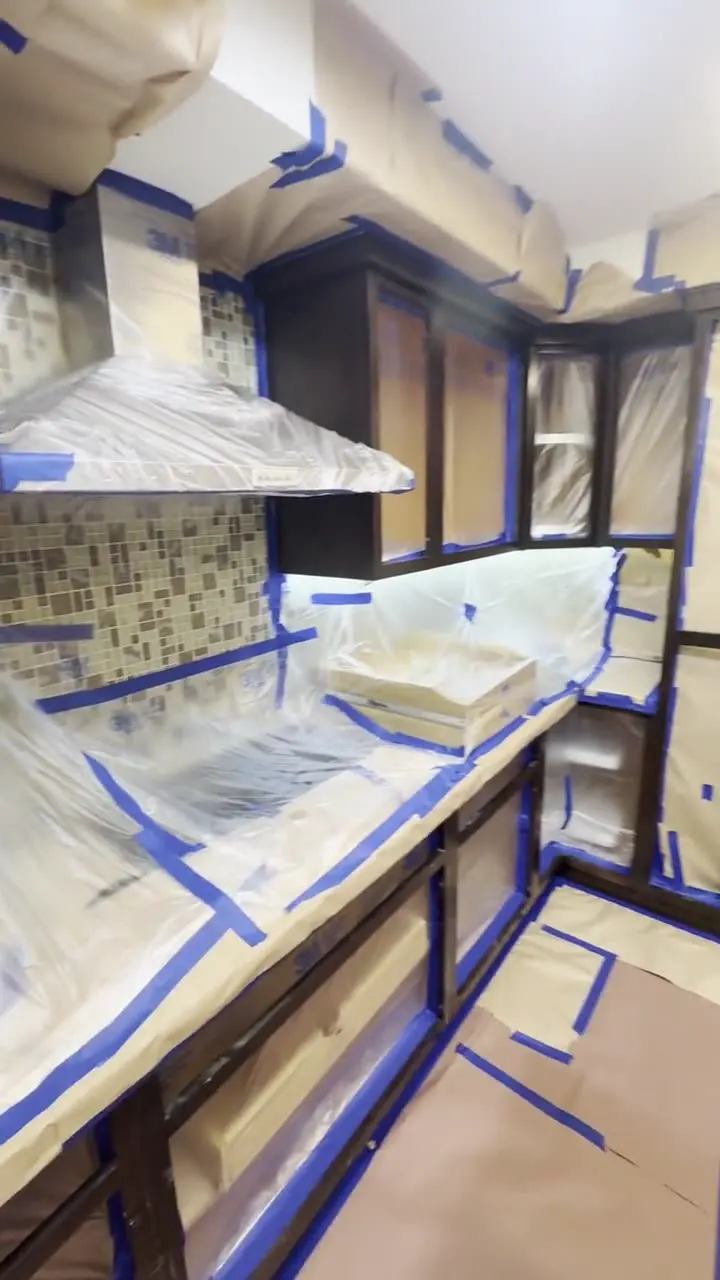
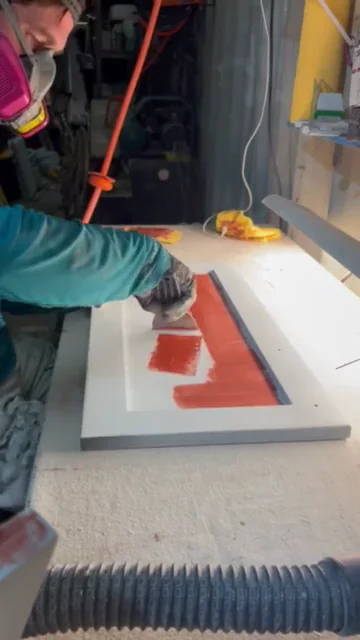
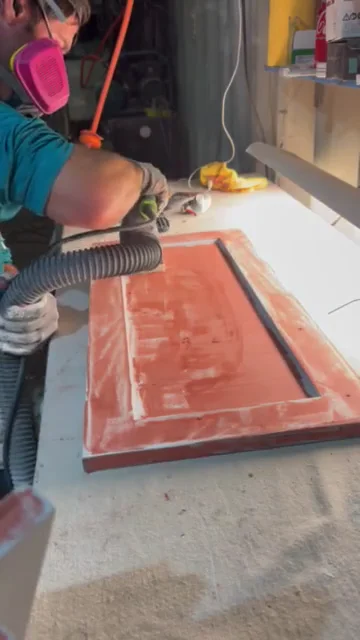
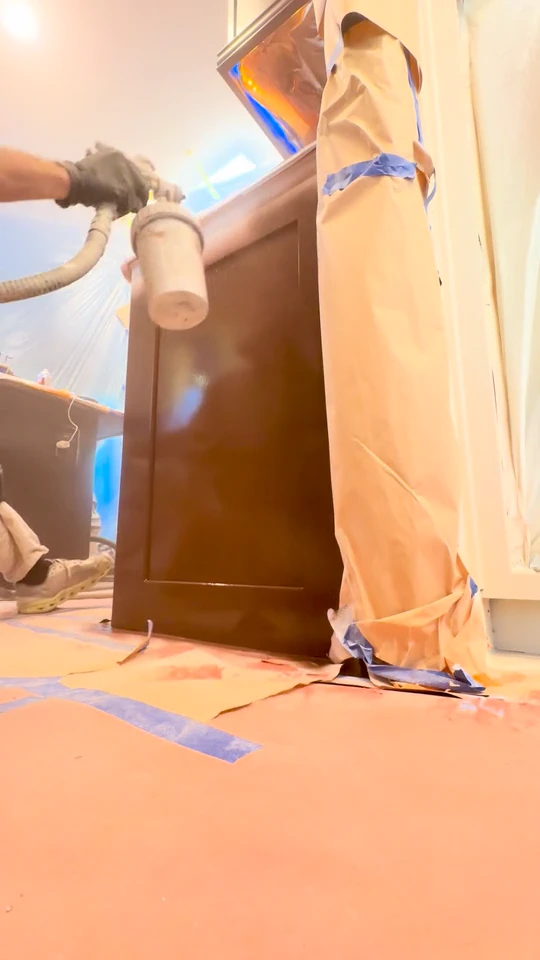
2K polyurethane costs more than one-part cabinet paint. Your quote also covers the preparation, shop finishing and drying time shown here.
Larger kitchens and grain filling take longer; your written quote gives the dates.
The 8 variables that change cabinet refinishing cost
These are the factors Tyler evaluates at every in-home estimate. Understanding them helps you estimate where your project will fall before Parallel Painting visits.
1. Door and Drawer Count
The single biggest cost driver. Each door and drawer front is individually removed, prepped, primed, and sprayed with multiple coats. More pieces equals more labor and more material, directly. Count your doors and drawers before calling — that number gives you the most useful ballpark.
2. Box Material
Solid wood and plywood cabinet boxes behave differently from MDF or thermofoil-wrapped boxes. Thermofoil and laminate are fine when they're still stuck down tight: same degrease, sand, and prime as any door. If they're bubbling or lifting, refinishing isn't a fit. MDF and smooth-faced doors skip grain filling, so they go faster. The prep approach and product selection change based on what you have — and that affects cost.
3. Current Finish Condition
Cabinets in good condition with an intact original finish require standard prep. Cabinets with heavy grease buildup, water damage, peeling previous paint, or extensive wear require more prep time. Failed previous paint jobs must be fully stripped before a new finish system can be applied. This is one of the variables Parallel Painting cannot see without an in-person visit — it can add meaningful time to the prep phase.
4. Grain Type
Oak is a common cabinet wood in many older kitchens. Its open grain can show through a painted finish. Grain filling is optional: shallow grain gets one skim cycle, while deep grain such as heavy red oak may need two. Maple, MDF, and smooth-faced doors usually skip this option. Filling follows an approved cured sample. Heavy oak comes out smooth to the touch with the pores filled, but it is still real wood: under bright side light you will see gentle waves from the grain, not the dead-flat look of MDF.
5. Door Style
Shaker and raised-panel doors have more surface area and profile detail than flat slab doors. More surface area means more material per coat and more spray time. Deeply recessed raised-panel profiles require careful spray technique to get even coverage in corners. Slab doors are the fastest to finish.
6. Timeline Constraints
Plan on about a week of work in your kitchen and about a week for the doors and drawer fronts in the shop. Larger kitchens and grain filling take longer; your written quote gives the dates. The schedule includes proper dry time between coats.
7. Glazing and Distressing Add-ons
Specialty decorative finishes — antiquing glaze, hand-distressed edges, multi-tone two-color schemes (different colors on uppers versus lowers) — require additional coats, additional dry time, and specialized technique. These add to the project scope and cost proportionally.
8. Hardware Changes
If you are upgrading to hardware with different hole spacing or mounting style, existing holes need to be filled and new holes drilled. Changing from cup pulls to bar pulls, or from knobs to European bar handles, typically requires fill-and-drill work on every door and drawer affected. This is a separate add-on quoted at the estimate.
- CSLB #1015608
- Yelp: 56 reviews, 4.8-star rating · Google: 10 reviews, 5.0-star rating
- 5-Year Written Warranty
Cabinet refinishing specialist
Sprayed cabinet finishes, done by Tyler.
- CSLB #1015608
- Tyler Fowler handles each project personally
- Two-component (2K) polyurethane
- 5-year written warranty
- Sealed containment and HEPA-vacuumed sanding
Why Tyler Prepares the Quote After an In-Home Visit
Cabinet refinishing cost in Temecula starts with a physical count of cabinet doors and drawer fronts, then moves up or down based on how much frame and panel work there is, wood grain, existing finish condition, interiors, additional colors, specialty finishes, hardware changes, and repairs. Tyler reviews these factors in person before preparing a fixed written quote for the agreed scope.
The free in-home estimate confirms the cabinet condition and project scope. Tyler visits your home, counts every door and drawer, assesses the wood species and grain structure, looks at the current finish condition, and reviews the layout — then hands you a written quote with a fixed number for the agreed scope. Anything you add later is written up and approved before it's done.
Peak-season projects may have a longer lead time before the start date. When comparing quotes, ask how an estimate becomes the final price and how unexpected conditions are handled. If a condition changes the scope, Tyler discusses it with the homeowner and documents any agreed change in writing before proceeding.
Refinishing, refacing, and replacement: scope considerations
For homeowners with sound boxes, refinishing is the lowest-cost of the three and keeps the layout you have. Here is how the three options compare for Temecula, Palm Desert, and Coachella Valley homeowners:
| Option | Cost Position | Timeline | Finish Lifespan | Scope Considerations |
|---|---|---|---|---|
| Refinishing | Lowest-cost option for structurally sound cabinets; priced by door and drawer-front count | Shortest of the three | Depends on use and care | Structurally sound cabinets with a workable layout |
| Refacing | Usually higher than refinishing because doors and drawer fronts are replaced | Mid-length | Varies | Changes doors and drawer fronts while keeping the existing boxes |
| Full Replacement | Highest-cost option | Longest of the three | Varies by brand | May involve structural work or layout changes |
Parallel Painting offers cabinet refinishing in Palm Desert using the same count-based pricing logic for Coachella Valley kitchens after Tyler verifies the kitchen in person. Refinishing preserves the existing cabinet boxes and replaces the dated finish. The coating is a two-component (2K) polyurethane system. Tyler assesses whether the cabinets are suitable for refinishing and explains its limits. If the boxes have structural damage, he explains that during the estimate.
How Parallel Painting prices every project
Every project starts with a free in-home estimate. Tyler visits your home, measures your cabinets, counts every door and drawer, assesses wood type and condition, and discusses finish options before writing a detailed written quote. The written quote fixes the price for the agreed scope. Any scope change is discussed and approved in writing before the additional work begins. Every project includes a written 5-year warranty: if the finish chips, peels, or blisters because of faulty prep, Tyler comes back and repairs it. Owner-operated; CSLB #1015608, licensed since 2016.
Tyler provides a fixed written quote after reviewing the kitchen in person for good reason: the variables that determine your price cannot be assessed from a description. Two kitchens with identical door counts can have very different pricing because one has thermofoil boxes and a failed previous paint job, while the other has solid maple in original factory condition. The 30-minute in-home visit supports a fixed written quote.
Tyler Fowler handles each project personally, from the estimate through the final walkthrough.
Why a refinish costs what it does
Here is the work a full refinish includes:
- Protect and prepare — The doors and drawer fronts are prepped at Tyler's shop. The cabinet boxes get the same prep in your kitchen, where you can see it done.
- Prime and smooth — Priming and surface correction is the longest step of the job. After the first primer coat, every door, drawer front and cabinet surface is skim-glazed with glazing putty, dents, gouges and open seams are spot-puttied, and everything is sanded back smooth. Doors and drawer fronts are checked on inspection tables under bright shop lights, and the cabinet boxes are checked in the kitchen with LED inspection light bars, so dents, sanding marks and uneven spots are found and fixed in primer, before the 2K topcoat goes on. The second primer coat goes on over that corrected surface, so the 2K topcoat lays down on a flat, uniform base. Open-grain oak can also be grain-filled for a glass-smooth door.
- Build the finish — The topcoats go on the same way as the primer: doors in the shop's spray booth, boxes in your kitchen's sealed, negative-pressure work area. Each coat gets the required drying time before the next step.
- Back together — Required drying time before handling and reinstallation, followed by alignment and the final walkthrough.
A fan draws air through a regular filter and vents outdoors to help control airborne dust, overspray, and fumes within the work area.
The quote and the written warranty are reviewed separately.
Add it up: a full kitchen is 60 to 100-plus hours of hands-on work.
Compare the preparation, coating system and finishing steps included in each written quote.
Frequently Asked Questions
Can I get a price over the phone or from photos?
Photos help Tyler see the job and plan the visit. The planning range on this page gives you a starting number; the fixed written quote comes after Tyler looks over the cabinets in person.
What variables change the price the most?
Eight factors shape the quote and project plan: (1) door and drawer count — the single biggest factor, each piece is individually prepped and sprayed; (2) box material — solid wood and plywood cabinets are different from MDF or thermofoil, which have their own prep requirements; (3) current finish condition — grease buildup, water damage, and previous paint failures require more prep time; (4) grain type — optional grain filling on open-grain oak adds one or two skim cycles depending on depth; (5) door profile — shaker and raised-panel doors have more surface area and detail than slab doors; (6) timeline constraints — proper dry time between coats and peak-season lead time affect the project plan; (7) glazing and distressing add-ons — specialty decorative finishes such as multi-tone color schemes, glazing, and distressing require additional coats and dry time; (8) hardware changes — if you are swapping hardware positions, hinge mortising or hardware fill-and-drill work adds labor.
What does cabinet refinishing cost per door in Temecula?
Standard single-color exterior cabinet refinishing commonly runs about $135–$185 per cabinet door and $95–$145 per drawer front before project-specific adjustments. This is Southern California planning guidance — not a price list. Each rate is per one physical cabinet door or drawer front — not per cabinet box. These planning ranges include the standard exterior work on your cabinets: door fronts and backs, drawer fronts, face frames, box exteriors, toe kicks, and side panels. They also include removal and reinstall, preparation, 2K polyurethane, HEPA-vacuumed sanding, sealed negative-pressure containment, and the 5-year written warranty. Tyler Fowler handles each project personally. Oak grain remains visible unless you choose grain filling. Three things set the price: Doors and drawer fronts: the per-piece range above, with the cabinet boxes, face frames, toe kicks, and side panels included. Grain filling: adds about $30–$85 per cabinet door and $10–$20 per drawer front, depending on how deep the grain is and whether the backs of the doors are filled too. Painted interiors: add about $35–$60 per cabinet door and $25–$45 per drawer front on average, depending on how many cabinets there are and the condition of the insides. Some interiors are prefinished and fine as they are. Small kitchens cost more per door, because the same sealed, negative-pressure work area still has to be built around them; failing old finishes, heavy damage, extra colors, repairs and specialty finishes also add to the price. A fan draws air through a regular filter and vents outdoors to help control airborne dust, overspray, and fumes within the work area. Tyler provides a fixed written quote after counting your doors and drawer fronts and looking over the cabinets in person. For a full kitchen, the door and drawer-front count is the starting point.
How does refinishing compare to refacing or replacement?
For structurally sound cabinets, refinishing preserves the existing boxes and updates the finish with a 2K polyurethane system. Refacing replaces doors and drawer fronts while keeping the same box layout. Full replacement changes the cabinetry itself and usually brings the most disruption, longest timeline, and highest cost. The refinishing window is: cabinets are structurally solid, hardware works, layout makes sense, and you want them to look new. Failing boxes, a layout that no longer works, or doors damaged beyond repair need an in-person assessment before a refinishing scope can be confirmed. Tyler explains the condition and the limits of refinishing at the estimate.
Why does 2K cabinet refinishing cost more than regular cabinet painting?
Because it's a different job. Doors and drawer fronts are removed, labeled, and finished in the shop. Before cabinet-box sanding begins, a sealed, negative-pressure work area is set up in the kitchen and maintained through spraying. Surfaces included in the written scope are degreased, sanded with a HEPA vacuum at the sander, primed, and finished with two to three sprayed coats of 2K polyurethane, with sanding between coats. The coating costs more than one-part cabinet paint. Compare the preparation, coating system and finishing steps included in each written quote. A fan draws air through a regular filter and vents outdoors to help control airborne dust, overspray, and fumes within the work area.
How do I compare two cabinet refinishing quotes?
Compare what each quote includes: whether doors are removed and sprayed in a shop, the coating system, primer and sanding between coats, who handles the work, and the written warranty. Tyler Fowler provides a fixed written quote after counting the doors and drawer fronts and reviewing the cabinets in person.
What is included in the price?
Everything listed in the written quote: standard surface preparation, primer and finish coats, painted door fronts and backs, the face frames, box exteriors, toe kicks and side panels, door and drawer-front removal, labeling, reinstallation, alignment, HEPA-vacuumed sanding, sealed negative-pressure containment, cleanup, and a written 5-year warranty. A fan draws air through a regular filter and vents outdoors to help control airborne dust, overspray, and fumes within the work area. Grain filling, interiors, repairs, hardware changes, extra colors, and specialty finishes are included only when listed. The coating is a two-component (2K) polyurethane system. The written price covers the agreed scope. If you request additional work or an unexpected condition requires a scope change, Tyler discusses it with you and gets the change approved in writing before proceeding.
Related Resources
- Cabinet Refinishing in Temecula — Parallel Painting's full service page for Temecula homeowners.
- How Long Does Cabinet Refinishing Take? — Phase-by-phase timeline breakdown.
- Will Painted Cabinets Peel? — Why coating choice and prep determine how cabinets hold up.
- Cabinet Painting vs Refinishing vs Refacing — Compare all your options.
- What Is 2K Polyurethane? — Why Parallel Painting uses a two-component (2K) polyurethane coating.
- Get Your Free Estimate — Schedule your free in-home estimate.
Related Services
Cabinet Refinishing in Temecula
Parallel Painting's signature 2K polyurethane refinishing service in Temecula.
How Long Does Refinishing Take?
Full timeline so you can plan around your kitchen downtime.
Will Painted Cabinets Peel?
Why coating choice and prep quality determine whether cabinets hold up.
2K Polyurethane Finish
Why Parallel Painting uses a two-component (2K) polyurethane coating on cabinets.
Painting vs Refinishing
Compare options and price ranges to find the best fit for your budget.
Next step
Plan an In-Home Estimate
Call or text Tyler for clear answers about your project and a fixed written quote.
Local cabinet cost guides
The Finished Result
A smooth, sprayed 2K finish on a kitchen island, refinished in place.
Watch the reflection · 0:04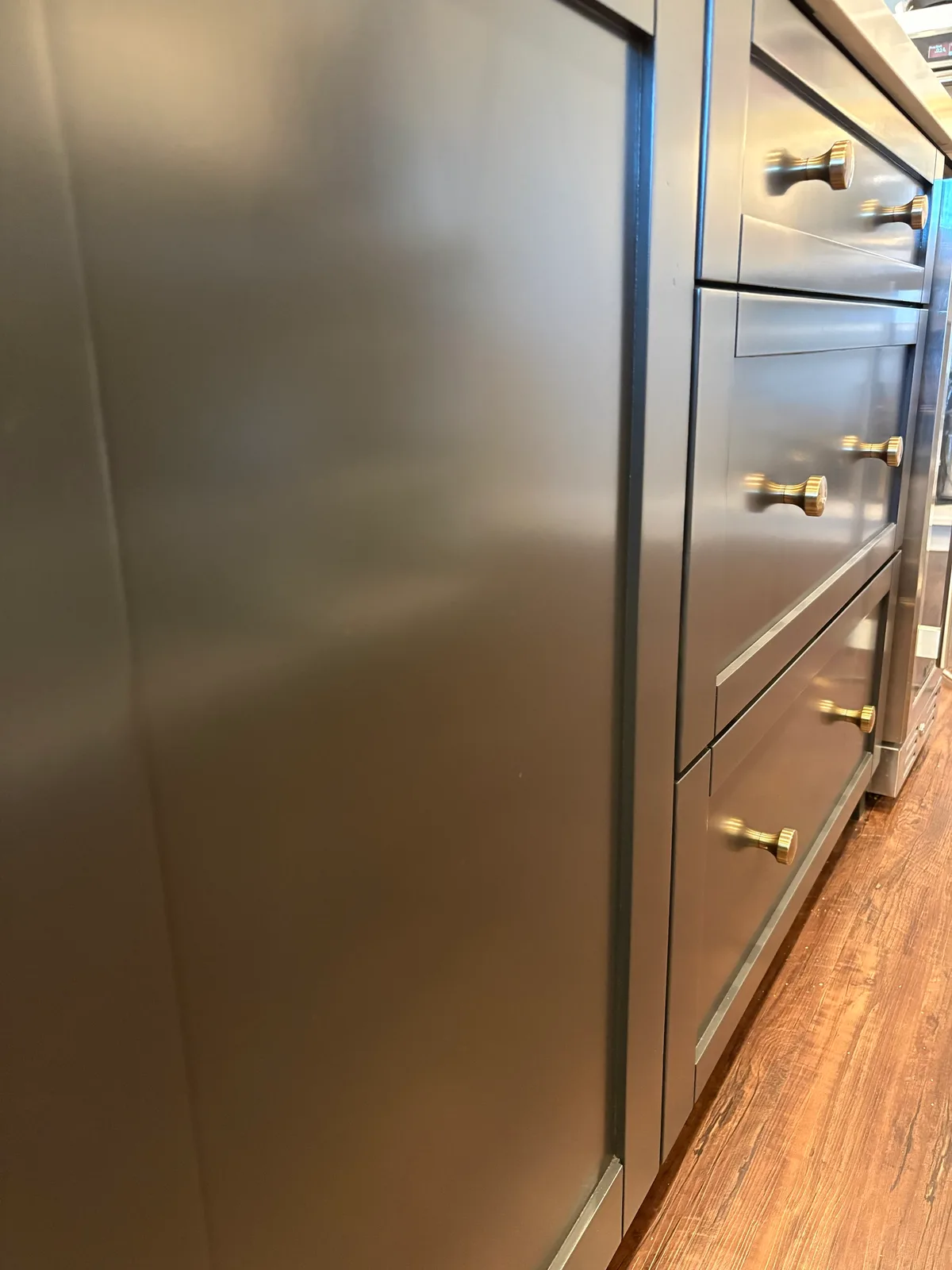
What goes into that finish
The work behind the finish.
The time is in the preparation, surface corrections, sanding and sprayed coating system. These are photos from Tyler’s process.
The Cabinet Refinishing Process
Four production phases, from door removal through the final walkthrough. Tyler Fowler handles each project personally.
Protect & clean
Remove and label the doors. Mask the kitchen, degrease and prepare the surfaces.
Cabinet box exteriors are sprayed in place, inside a sealed, negative-pressure work area that is set up in the kitchen before sanding begins and stays in place through spraying.
A fan draws air through a regular filter and vents outdoors to help control airborne dust, overspray, and fumes within the work area.
Protect and prepare
The doors and drawer fronts are prepped at Tyler's shop. The cabinet boxes get the same prep in your kitchen, where you can see it done.
Prime & correct
The longest step. Two primer coats. Between them, every surface is skim-coated with glazing putty, dents and seams are spot-puttied, and it is all sanded smooth. Every surface is checked under bright inspection lights before the topcoat. Optional grain filling.
Sand smooth
Sand the corrections, primer and between topcoats. Each coat needs drying time.
Sanding is HEPA-vacuumed, and the cabinet exteriors are finished in 2K polyurethane.

Spray & reinstall
Spray two to three 2K topcoats. Reinstall and align the doors once ready.
Doors and drawer fronts are sprayed in the negative-pressure booth at the shop.
Cabinet boxes are sprayed in place inside the sealed work area.
Build the finish
The topcoats go on the same way as the primer: doors in the shop's spray booth, boxes in your kitchen's sealed, negative-pressure work area. Each coat gets the required drying time before the next step.
Back together
Required drying time, reinstallation, alignment, and the final walkthrough.
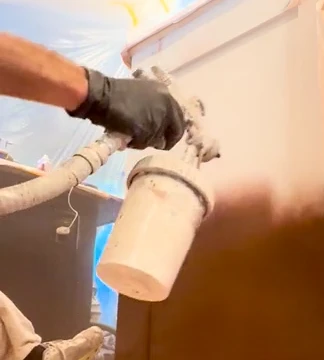
2K polyurethane costs more than one-part cabinet paint. Your quote also covers the preparation, shop finishing and drying time shown here.
Larger kitchens and grain filling take longer; your written quote gives the dates.
Quote and written warranty review →
More process close-ups
Finish proof
The finish, up close

Cabinet refinishing in Temecula
Keep your kitchen.
Change the finish.
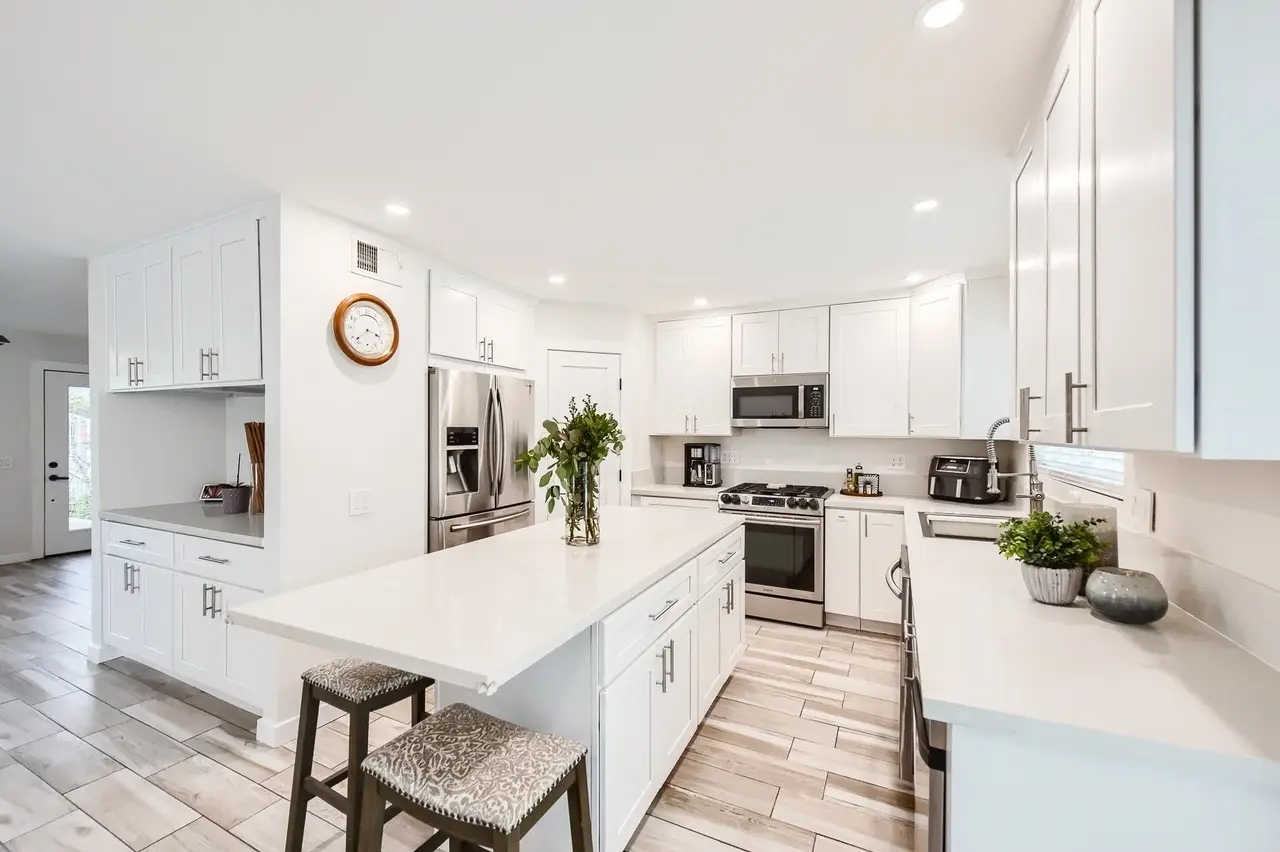
Sound cabinets and a layout you like? Refinish the cabinets you already own in sprayed 2K polyurethane.
- A sprayed cabinet finishTwo-component 2K polyurethane, with preparation and sanding between coats.
- Tyler handles your projectFrom the in-home estimate through reinstall and the final walkthrough.
- A written prep warrantyFive years for chipping, peeling or blistering caused by faulty preparation.

Meet Tyler
Tyler Fowler handles each project personally, from the estimate through the final walkthrough. Melissa handles scheduling and the phone; you can always ask for Tyler.
- One jobat a time, Tyler on site
- 5 yearswritten warranty on prep
- Samplesin your own kitchen
- 2016CSLB #1015608 since
Why Homeowners Choose Parallel Painting
Sprayed 2K polyurethane, a sealed negative-pressure work area, careful preparation and a written 5-year warranty.
2K Polyurethane
A factory-grade, two-component catalyzed polyurethane, sprayed with HVLP in two to three topcoats.
HEPA-Vacuumed Sanding
Industrial HEPA vacuums hooked to sanders during prep.
Sealed Negative-Pressure Containment
Before sanding starts, Tyler seals the work area and establishes negative pressure.
Owner-Operated
Tyler Fowler handles each project personally, from the estimate through the final walkthrough.
The Coating System
Sprayed 2K Polyurethane, Built Over Real Prep
Every door and drawer front comes off, gets cleaned and sanded, and is sprayed in the negative-pressure booth at Tyler's shop. The cabinet boxes get the same 2K polyurethane right in your kitchen, sprayed inside a sealed, negative-pressure work area that Tyler sets up before sanding begins and keeps in place through spraying. Sanding is HEPA-vacuumed. Priming and surface correction is the longest step of the job. After the first primer coat, every door, drawer front and cabinet surface is skim-glazed with glazing putty, dents, gouges and open seams are spot-puttied, and everything is sanded back smooth. Doors and drawer fronts are checked on inspection tables under bright shop lights, and the cabinet boxes are checked in the kitchen with LED inspection light bars, so dents, sanding marks and uneven spots are found and fixed in primer, before the 2K topcoat goes on. The second primer coat goes on over that corrected surface, so the 2K topcoat lays down on a flat, uniform base. Open-grain oak can also be grain-filled for a glass-smooth door. 2K is a two-component catalyzed finish: it chemically cures into a hard, tough shell instead of just drying like paint.
- Factory-grade two-component (2K) polyurethane, sprayed
- Doors and drawer fronts sprayed in a negative-pressure booth at the shop
- Cabinet boxes sprayed in place inside a sealed, negative-pressure work area
- HEPA-vacuumed sanding, multiple finish coats on every kitchen. Prime & correct. The longest step. Two primer coats. Between them, every surface is skim-coated with glazing putty, dents and seams are spot-puttied, and it is all sanded smooth. Every surface is checked under bright inspection lights before the topcoat. Optional grain filling.
Reviews
Client Reviews
Read reviews on Google and Yelp
“Tyler's work was meticulous. The cabinets look new. The wear, tear, and damage is gone. I could never have done this quality of work myself.”
“Tyler’s workmanship is exceptional! He’s meticulous when it comes to his work. He refinished our kitchen cabinets and they look amazing! I highly recommend Parallel Painting!”
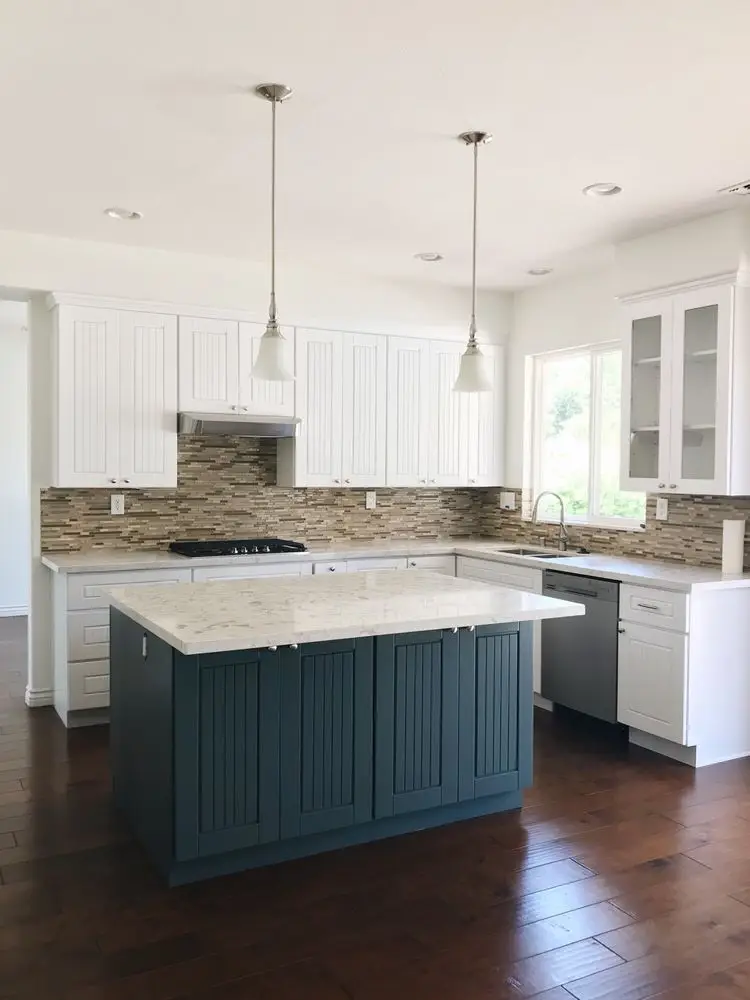
“He turned our beech colored wood shaker cabinets into white cabinets and painted our island blue for a nice pop of color. You can tell Tyler takes pride in his work and is very meticulous to every single detail.”
“He also painted my kitchen cabinets and my bedroom doors and trim as well as the front door. So basically everything in my tiny 600 ft condo. It came out gorgeous. He's on time and a meticulous worker.”
Next step
Ready for a Factory-Grade Finish on Your Cabinets?
Tyler takes one job at a time, and Melissa handles his schedule and the phone. Call or text for an in-home estimate.
Call or text Tyler: (951) 551-0583