
Cabinet Refinishing FAQ
Clear answers about Parallel Painting’s process, pricing, and what to expect.
Pricing guidance last verified October 5, 2026.
Cost and pricing
Because it's a different job. A full kitchen is 60 to 100-plus hours of hands-on work. Doors and drawer fronts are removed, labeled, and finished in the shop. Before cabinet-box sanding begins, a sealed, negative-pressure work area is set up in the kitchen and maintained through spraying. Surfaces included in the written scope are degreased, sanded with a HEPA vacuum at the sander, primed, and finished with two to three sprayed coats of 2K polyurethane, with sanding between coats. A fan draws air through a regular filter and vents outdoors to help control airborne dust, overspray, and fumes within the work area.
The coating itself costs more than one-part cabinet paint. Compare the preparation, coating system and finishing steps included in each written quote.
Compare what each one includes, not just the total:
- Do the doors come off and get sprayed in a shop, or are they painted in place?
- Is it a one-part paint or a 2K polyurethane?
- Is there primer, and sanding between coats?
- Who actually does the work?
- Is the prep warrantied in writing?
Tyler's written quote spells out each of those, so you can line it up against anyone else's.
No. Estimates are free and in person: Tyler comes out, counts every door and drawer front, checks the cabinets' condition, and gives you a fixed written quote.
Is refinishing right for your kitchen?
Usually, yes, if your cabinet boxes are solid and you like your layout. Refinishing keeps the cabinets you already own and gives them a sprayed 2K polyurethane finish. When the cabinet boxes are structurally sound and the layout works, refinishing usually costs less than replacement and avoids cabinet demolition and new countertops.
It isn't worth it when the boxes are water-damaged, the doors are falling apart, or you want a different layout. Tyler Fowler tells you which one you are at the free in-home estimate, and the prep carries a written 5-year warranty.
Refinishing means Parallel Painting retains the cabinet boxes, doors, and drawers, then transforms the surfaces with a full prep-and-spray process: degrease, sand, apply the first coat of high-build 2K primer, correct the surface and grain-fill on oak when you choose it, sand, apply a second primer coat, sand, and spray two to three finish topcoats. The coating is a two-component (2K) polyurethane system. The structure stays; only the finish changes.
Refacing means replacing the doors and drawer fronts entirely with new ones and applying a laminate or wood veneer over the existing boxes. It usually costs more than refinishing. Refacing makes sense if your existing doors are structurally failing or you want a door style the original cabinets cannot accommodate.
Full replacement means tearing out and rebuilding, usually the highest-cost and most disruptive path.
For most homeowners with structurally sound cabinets, refinishing keeps the existing boxes and usually costs less than refacing or full replacement.
Yes, as long as it's still stuck down tight. Laminate and thermofoil get the same prep as any cabinet: degreased, sanded, and primed before the 2K polyurethane goes on.
If it's bubbling, peeling, or lifting at the edges, the bond underneath has already failed, and no coating will fix that. That's one of the cases where refinishing isn't a fit. One honest note: if the original thermofoil lets go later, that's the old surface failing, not the prep, so the prep warranty doesn't cover it.
Usually, as long as the old paint is still stuck tight. Tyler tests it first, including a quick solvent rub that shows whether the existing finish is soft. If the old paint is peeling, it has to come off before anything new goes over it, or the new finish peels with it. More on that: fixing peeling painted cabinets.
The 2025 Cost vs. Value report estimated that a minor kitchen remodel — new cabinet fronts, counters, appliances, sink, and flooring — could recoup about 113% of its cost. That figure covers the broader remodel rather than cabinet refinishing alone.
Refinishing solid cabinets retains the existing boxes. The cost depends on cabinet condition and project scope; a written estimate can help assess whether refinishing fits the project.
No, but the mix is shifting. In Houzz's 2026 kitchen trends study of renovating homeowners, wood-tone cabinets edged out white, 29% to 28%, and about a quarter chose two-tone kitchens with different upper and lower colors.
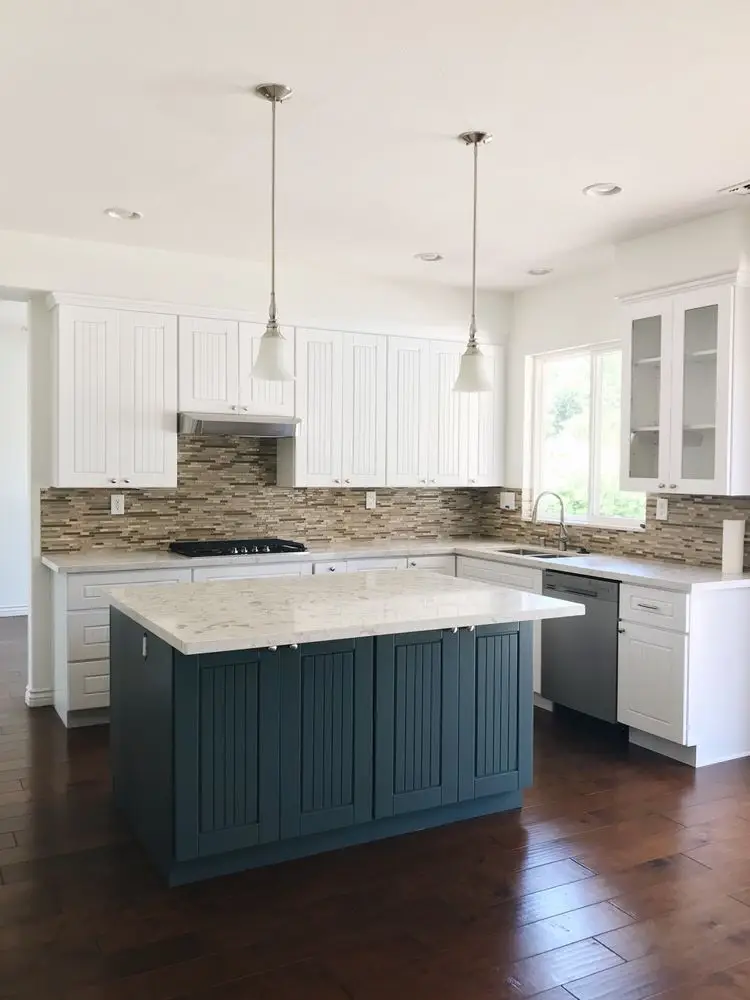
White, wood tones, and contrasting island colors are options Tyler can discuss during the estimate.
Not when they're sprayed over real prep. What makes cabinets look "painted" is brush marks, paint piled in the corners, and edges worn through to wood. Tyler sprays every door, drawer front, and box in 2K polyurethane after degreasing, sanding, and priming, so the result reads like a factory finish.
On oak, you choose whether the grain shows. Filling it is optional, and you see a cured sample first.
The process
A two-component (2K) polyurethane, sprayed. 2K is a catalyzed finish: it chemically cures into a hard, factory-grade shell instead of just drying like paint, which is why it holds up on doors and drawers that get handled every day.
Doors and drawer fronts are sprayed in the negative-pressure booth at Tyler's shop; the cabinet boxes are sprayed in place inside a sealed, negative-pressure work area in your kitchen. Want a specific coating system, such as an Italian 2K? Ask Tyler about the upgrade.
Every cabinet project is backed by a written 5-year warranty: if the finish chips, peels, or blisters because of faulty prep, Tyler comes back and repairs it.
The topcoats are sprayed. High-build primer is sprayed and also rolled into deeper grain where needed. Doors and drawer fronts go through the negative-pressure booth at his shop, and the boxes are sprayed in place inside a sealed, negative-pressure work area. A fan draws air through a regular filter and vents outdoors to help control airborne dust, overspray, and fumes within the work area.
Off. Every door and drawer front is removed, labeled, and taken to Tyler's shop, where it's sprayed in a negative-pressure booth: fronts, backs, and edges.
The cabinet boxes stay on the wall and are sprayed in place inside a sealed, negative-pressure work area built in your kitchen.
No. Hinges and hardware come off with the doors, go into labeled containers, and go back on after the finish cures, so nothing gets painted over them. If you want new pulls or hinges, that's an add-on: it's only included when it's listed on your quote.
Most kitchens take two to three weeks, start to finish. Only about a week of that is work in your home; the doors and drawer fronts are finished in the shop. A full kitchen is 60 to 100-plus hours of hands-on work, and Tyler takes one job at a time.
Bigger kitchens, oak grain filling, repairs, and painted interiors add time. You get the schedule with your written quote.
During the job
Here's how it works. The cabinet boxes are sprayed inside a sealed, negative-pressure work area, with an exhaust fan with a regular filter venting outside, and Tyler wears a respirator while he sprays. While spraying is going on, family and pets stay out of that area until Tyler gives the all-clear, and he goes over the plan for your household before work starts.
Doors and drawer fronts are sprayed at the shop, not in your home. Follow the written household-care instructions after the finish has cured.
It's real work in your kitchen, so the work area is contained. Before any sanding, the kitchen gets masked: counters, appliances, and floors covered and taped, and every cabinet opening masked off. A sealed, negative-pressure work area is established before sanding and maintained through spraying. A fan draws air through a regular filter and vents it outdoors to help control airborne dust, overspray, and fumes within the work area; sanding uses a HEPA vacuum at the sander. Doors and drawer fronts are sprayed at the shop.
When the job's done, the containment comes down and the kitchen gets cleaned. Watch a masked kitchen on a real job.
Yes, empty everything before Tyler starts. The doors come off and every cabinet opening gets masked so the insides stay clean, so anything left inside would sit in a taped-off box for the length of the job. Stage it on the dining table, pantry shelves, or in bins the day before.
You don't need to touch the hinges, drawer slides, or shelf pins; Tyler handles all of that. You don't need to empty the fridge or a walk-in pantry either, just the cabinets, drawers, and any open shelving. If space is tight, Tyler can help you plan it at the in-home estimate.
Preparation on your end is simple:
- Empty all cabinets and drawers the day before Parallel Painting arrives. Dishes, glassware, pantry items, and stored cookware go on a dining table, garage workbench, pantry shelves, or in stackable bins for the duration of the project.
- Clear countertops near the work zone so Parallel Painting has room for containment framing, drop cloths, and prep work.
- Ensure Parallel Painting has access to a water source and a standard electrical outlet during the working hours.
- Remove fragile items, small artwork, and valuables from the kitchen area — anything that cannot handle minor bumping during door removal and containment setup.
- If you have pets, decide on a quiet-area plan for them during the louder prep and sanding hours.
Parallel Painting handles the refinishing work, including door and drawer removal, hardware labeling, containment setup, surface preparation, any grain filling listed in the quote, priming, spraying, off-site transport, reinstallation, alignment, and cleanup.
After the job
There is no single number that fits every kitchen, because how a kitchen is used and cleaned matters as much as the finish. What Tyler can put in writing is the prep: if the finish chips, peels, or blisters because of faulty prep within 5 years, he comes back and repairs it. Good adhesion starts with proper prep, so that's the part he backs.
After that, care decides the rest: skip harsh cleaners and scrub pads, and wipe up water and steam around the sink and dishwasher. More in caring for refinished cabinets.
A properly prepped, sprayed 2K finish shouldn't peel. Any finish can chip if it takes a hard enough hit. Peeling is different: it means something lost its grip, whether that's the prep, an old layer underneath, or water getting in. Good adhesion starts with degreasing, sanding with a HEPA vacuum at the sander, and primer before the topcoats.
If it's the prep, that's on Tyler Fowler, in writing, for 5 years: if the finish chips, peels, or blisters because of faulty prep, he comes back and repairs it. If it's something else, he'll show you what failed and why.
Say so at the final walkthrough. Tyler walks every door and drawer with you, and anything that needs adjusting or touching up gets fixed before the job is called done. After that, the written 5-year warranty covers chipping, peeling, or blistering caused by faulty prep: Tyler comes back and repairs it.
Choosing a refinisher
Ask these, and compare the answers side by side:
- Do the doors come off? Are they sprayed in a shop, or painted in place?
- What coating? A one-part paint or a 2K polyurethane?
- How will they protect and vent your kitchen? Masking, containment, and where the overspray and fumes go.
- Who will be on site each day?
- When can you use the kitchen normally again?
- Are they licensed? In California almost any cabinet job needs a contractor's license (the exemption stops at $1,000 in labor and materials). Check the number at cslb.ca.gov before you sign.
- Is the prep warrantied in writing?
Then ask for photos of their own jobs. Tyler's answers: doors to the negative-pressure booth at his shop, sprayed 2K polyurethane, boxes sprayed inside a sealed, negative-pressure work area vented outside, Tyler Fowler handling the project personally, CSLB License #1015608, and a written 5-year warranty on the prep.
Tyler Fowler handles each project personally, one job at a time, from the estimate through sanding, spraying, and reinstallation.
You can, and plenty of people do. The hard parts are the ones that don't show in photos: taking every door off, degreasing, sanding, priming, and getting a smooth sprayed finish with no brush marks.
2K coatings like the one Tyler uses also need spray equipment and serious breathing protection, which is why they're mostly a pro product. If you'd rather not give up weekends to prep, Parallel Painting handles the full process, one kitchen at a time.
Parallel Painting serves homeowners across Southwest Riverside County and the Coachella Valley, including:
- Southwest Riverside County: Temecula, Murrieta, Menifee, Wildomar and Lake Elsinore
- Nearby Fallbrook: Fallbrook
- Coachella Valley: Palm Desert, Palm Springs, Rancho Mirage, Indian Wells, and La Quinta
Tyler is based in Anza, California. Service availability is confirmed after the project location and scope are reviewed. Tyler Fowler handles each Parallel Painting project personally, from the estimate through the final walkthrough. If you are unsure whether your home is in the service area, call (951) 551-0583.
Cabinet refinishing specialist
Sprayed cabinet finishes, done by Tyler.
- CSLB #1015608
- Tyler Fowler handles each project personally
- Two-component (2K) polyurethane
- 5-year written warranty
- Sealed containment and HEPA-vacuumed sanding
Still Have Questions?
Call or text to discuss your project.