
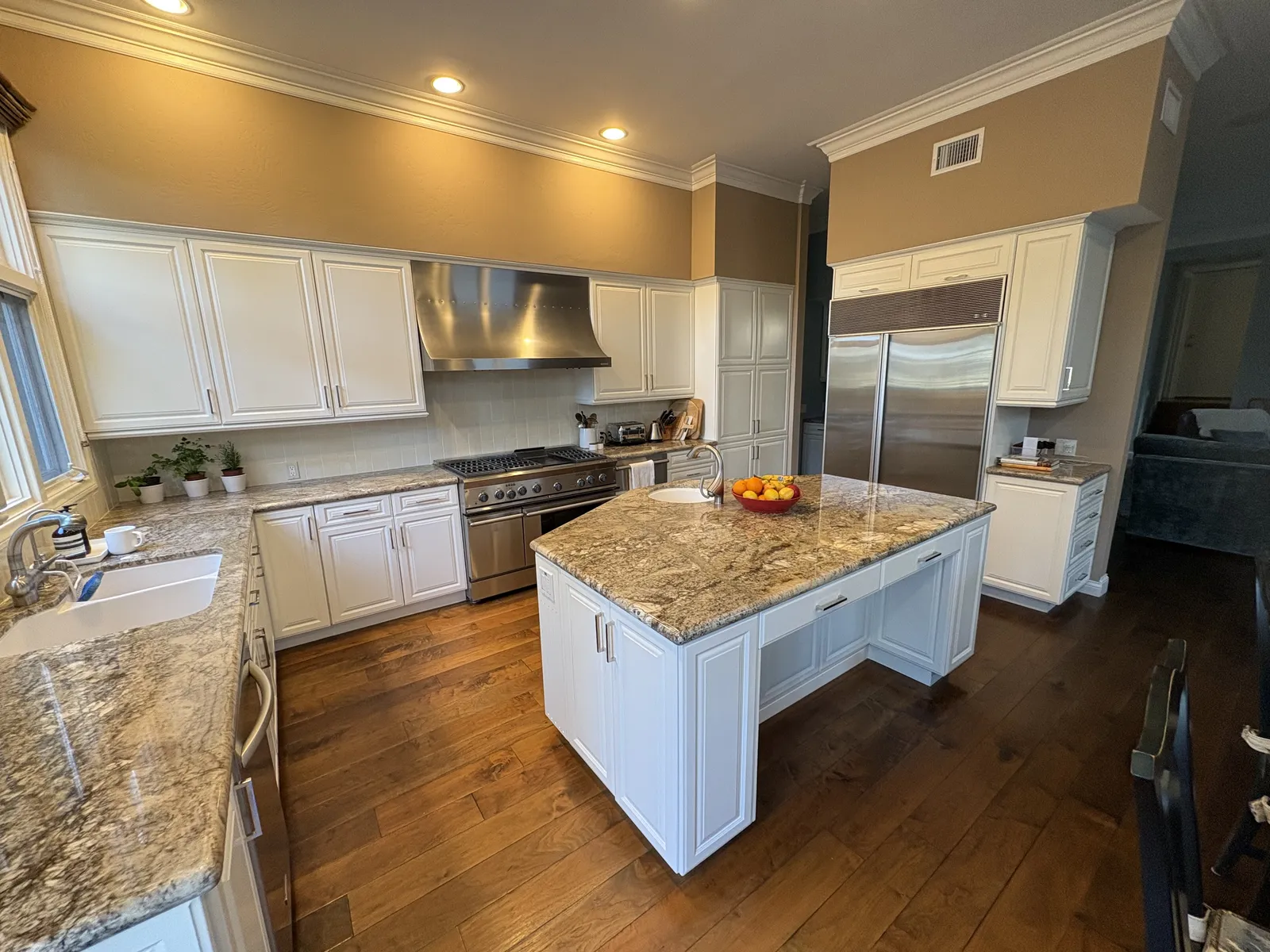
“How much does cabinet refinishing cost?” is the first question I get on almost every call. It’s a fair question, and it deserves a straight answer about what actually drives the number — not a vague “it depends” with no explanation.
So here’s the honest breakdown from someone who does this every day. This is a decision guide: I’ll explain what determines the price, what to ask, and how to tell a real refinish from a shortcut. For a number tied to your specific kitchen, you’ll want a written quote in person.
The Quick Answer
Cabinet refinishing isn’t priced like a flat product — it’s priced by the scope of your kitchen. The single most useful thing you can do before any quote is count your cabinet doors and drawer fronts, because those are the pieces that actually get removed, prepped, and sprayed.
From there, the quote depends on frames, panels, wood grain, existing finish condition, interiors, color changes, specialty finishes, hardware changes, repairs, and layout complexity. Two kitchens with the same door count can land in very different places once those factors are accounted for.
That’s why I give a written quote after seeing and counting the kitchen in person — it’s the only honest way to put a real number on your project.
What Determines Your Price
Cabinet refinishing cost is driven by six factors. Understanding them helps you evaluate quotes and know what you’re actually paying for.
1. Door and Drawer-Front Count
This is the biggest variable. Most estimates are based on cabinet door and drawer-front count as the primary sizing metric, since that’s what actually gets removed, prepped, and sprayed.
A typical Temecula tract kitchen has 20-30 doors and 10-15 drawer fronts. A larger custom kitchen might have 35-50 doors plus matching panels and trim.
2. Coating System
This is the factor most homeowners overlook — and it’s worth pinning down in writing.
Different coating products carry different material costs, and that’s one of several factors in a quote. Ask each contractor for the exact coating product and current technical documents rather than relying on a category label.
Parallel Painting’s cabinet-finishing process uses a two-component (2K) polyurethane system. There’s a real material cost difference between products, but labor and preparation are the bigger drivers of the overall price.
3. Preparation Quality
Preparation is where a quote can quietly get cheaper, so it’s worth confirming in writing. Proper preparation for cabinet refinishing includes:
- Degreasing — Kitchen cabinets accumulate years of cooking grease, especially near the stove. This must be chemically removed before any sanding.
- Sanding — Every surface needs to be sanded to remove the gloss uniformly before the new finish. This means 120 to 150 grit before primer, 220 after the first primer coat and surface corrections, and 320 after the second primer coat.
- Grain filling — Oak, ash, and other open-grain woods need a high-build primer to fill the grain texture. Without this step, every grain line shows through the paint. This step alone adds meaningful time to a project.
- Repair — Dents, chips, cracks, and damaged edges need to be filled and sanded smooth after the first coat of high-build 2K primer and before the second.
- Caulking — Gaps between face frames and walls need to be sealed for a finished look.
When a quote comes in notably low, ask each contractor for the exact preparation steps and confirm what is removed, repaired, masked, coated, cured, and reinstalled. A finish can look acceptable at first, but skipped prep is the most common reason a finish stops holding later.
4. Application Method
Application method affects both the finished look and the setup involved. When you compare quotes, confirm in writing how each contractor plans to apply the coating, and ask to see examples of their finished cabinet work.
Spray application requires significantly more setup. The painter needs to mask everything not being painted and use professional spray equipment. The sealed, negative-pressure work area is set up before any sanding and stays sealed through spraying. Parallel Painting uses spray application for its cabinet-finishing process; other manufacturer-approved cabinet products may permit brush, roller, or spray application.
5. Scope
Beyond standard cabinet doors and drawer fronts, many kitchens include:
- Islands — Typically 4-8 additional doors plus panels
- Pantry cabinets — Often taller with more surface area
- Crown molding and trim — Requires careful detail work
- Interior painting — Some homeowners want shelves and interiors painted too (this roughly doubles the work)
- Hardware changes — New holes means filling old holes and drilling new ones
Each of these adds labor and material.
6. Access and Logistics
A ground-floor kitchen with easy access is the simplest scenario. Upper-floor condos, tight layouts, and long carries to the truck add handling time, and every kitchen still needs a sealed, negative-pressure work area built inside the home. Townhomes with HOA restrictions, homes with no workspace nearby, or kitchens with unusual layouts all add complexity and time.
Why Cheap Jobs Cost More in the Long Run
A meaningful part of my business is fixing cabinet jobs that didn’t hold up. The pattern is usually similar:
- Homeowner gets a few quotes at different price points.
- They choose the cheapest because “it’s just paint.”
- The job goes quickly and looks okay at first.
- Later, problems show up — often at the grip edges, near the oven, or near the sink, where a kitchen is hardest on a finish.
- Eventually the homeowner calls to have the kitchen redone.
Now they’ve paid for the first job and again to strip and redo it properly, and lived through two rounds of disruption. The total cost and frustration end up higher than doing it right the first time.
This isn’t hypothetical — I see it regularly. The coating system and preparation quality are the biggest factors in how long a refinishing job holds up. No finish is immune to wear, but the right coating and proper prep make a real difference.
How to Evaluate Quotes
When you’re comparing estimates for cabinet refinishing, ask these specific questions:
- What coating are you using? Get the brand name and product type. “Cabinet paint” isn’t an answer.
- How do you handle grain filling? If the answer is “we don’t” and you have oak cabinets, walk away.
- Are you spraying or brushing? Confirm the application method in writing. Parallel Painting uses spray application for its cabinet-finishing process; other manufacturer-approved cabinet products may permit brush, roller, or spray application.
- How many coats of primer and finish? Minimum should be one coat primer, two coats finish. Confirm the coat schedule the contractor plans to use in writing.
- How long will the project take? A proper refinishing job takes time for prep, priming, multiple coats, and cure — the exact length depends on the size and scope of the kitchen. If someone promises it done in a day or two, ask how they’re fitting in real prep and cure time.
- Do you carry a CSLB license and insurance? In California, larger home-improvement projects require a licensed contractor. Ask for the number and verify it at cslb.ca.gov.
My Pricing Philosophy
Parallel Painting’s cabinet-finishing process uses a two-component (2K) polyurethane system, and I won’t be the cheapest quote on most kitchens. Here’s why I’m comfortable with that:
Every kitchen I refinish comes with a five-year written warranty. I stand behind my prep in writing; the coating itself is covered by its manufacturer. I’d rather do the work in a way I can put my name on than win a job on price alone.
The homeowners who choose Parallel Painting generally aren’t looking for the cheapest option. They’re looking for work done right the first time.
Ready to find out what your kitchen would cost? I offer free in-home estimates where I assess your cabinets, count the doors and drawer fronts, discuss the process and finish options, and give you a written quote — no surprises, no hidden fees. Schedule your free estimate or call me at (951) 551-0583.
Learn more about our cabinet painting costs in Temecula and what makes our two-component (2K) polyurethane system different.