
What Have Temecula Valley and Coachella Valley Kitchens Taught Parallel Painting About Cabinet Refinishing?
A practical look at Temecula Valley and Coachella Valley kitchens: the 2K polyurethane Tyler sprays on every cabinet job, the common cabinet materials Parallel Painting sees, and the local climate that shapes each finish.
- CSLB #1015608
- Yelp: 56 reviews, 4.8-star rating · Google: 10 reviews, 5.0-star rating
- 5-Year Written Warranty
See the finish up close · 0:12
The Finished Result
A black kitchen island in Temecula, prepared and sprayed in 2K polyurethane by Tyler.
Tap play to inspect the finish. 0:12 · No sound.
Watch a black kitchen island refinished in Temecula (0:12)
What goes into that finish
The work behind the finish.
The time is in the preparation, surface corrections, sanding and sprayed coating system. These are photos from Tyler’s process.

Protect & clean
Remove and label the doors. Mask the kitchen, degrease and prepare the surfaces.
Prime & correct
The longest step. Two primer coats. Between them, every surface is skim-coated with glazing putty, dents and seams are spot-puttied, and it is all sanded smooth. Every surface is checked under bright inspection lights before the topcoat. Optional grain filling.
Sand smooth
Sand the corrections, primer and between topcoats. Each coat needs drying time.
Spray & reinstall
Spray two to three 2K topcoats. Reinstall and align the doors once ready.
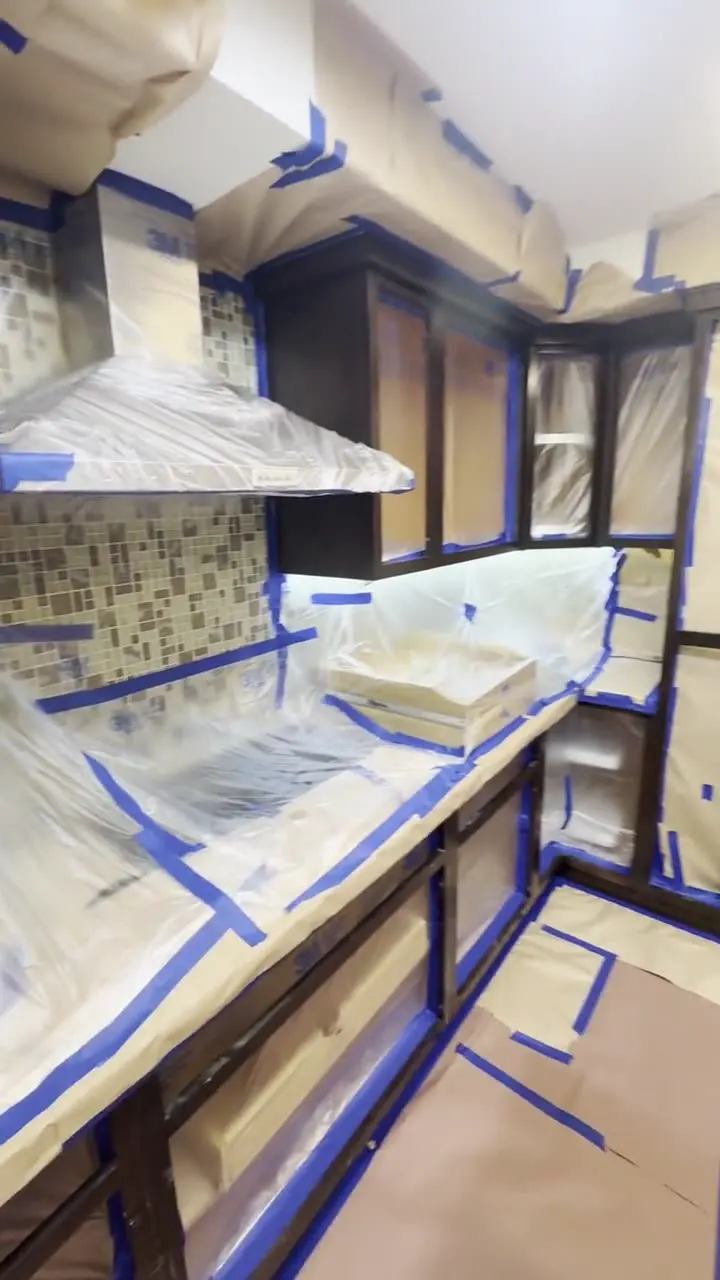
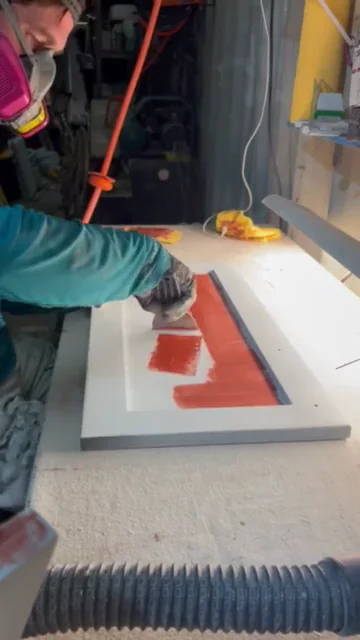
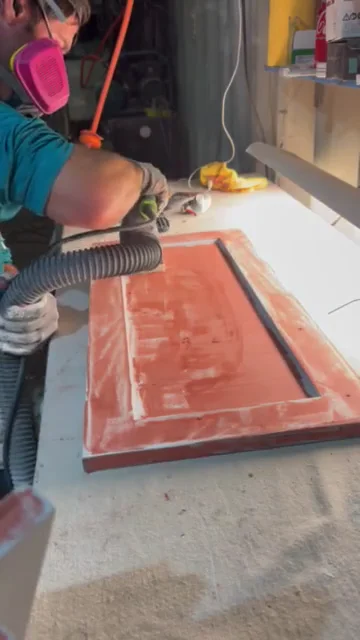
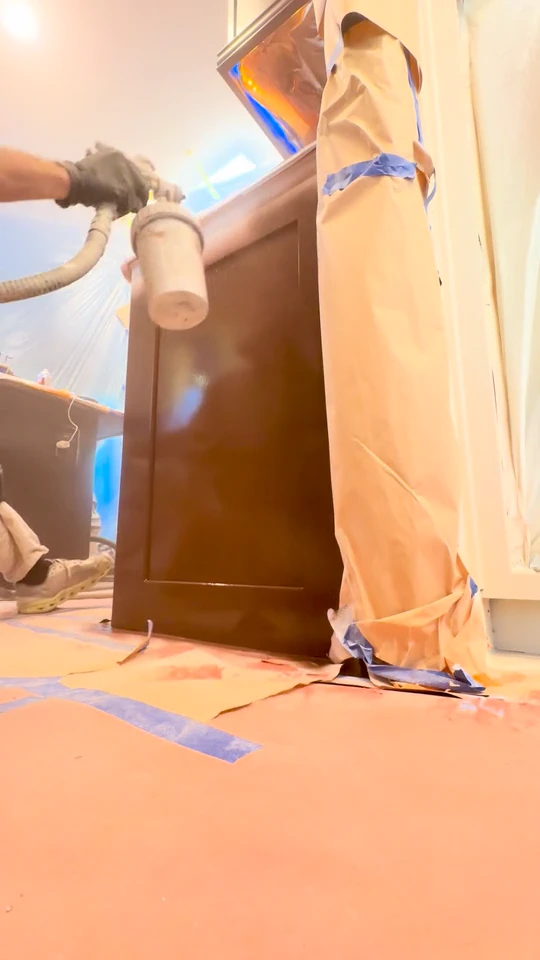
2K polyurethane costs more than one-part cabinet paint. Your quote also covers the preparation, shop finishing and drying time shown here.
Larger kitchens and grain filling take longer; your written quote gives the dates.
These notes describe the cabinetry and conditions common across Temecula Valley, Fallbrook, and the Coachella Valley. Every kitchen is evaluated by Tyler Fowler in person, and every finish recommendation is based on the same practical questions: what the cabinet boxes are made from, what finish is on them now, whether optional grain filling is included in the selected scope, how much heat and UV exposure the kitchen will see, and whether refinishing is actually the right path.
This is not published as a statistical study. It is a practical field-notes page for homeowners comparing cabinet refinishing, cabinet painting, refacing, and replacement. Where Tyler has not published a verified number, the page stays qualitative instead of pretending a percentage exists.
Which areas and cabinet types does this report cover?
Parallel Painting serves the Temecula Valley, nearby Fallbrook, and the Coachella Valley. Cabinet stock differs by area, which is what makes the regional picture worth laying out: production tract oak in Southwest Riverside County, custom alder and cherry in some Fallbrook-area and custom homes, and desert-exposed cabinetry in Palm Desert, Palm Springs, Rancho Mirage, Indian Wells, and La Quinta.
Parallel Painting refinishes cabinets across these service-area cities:
- Temecula
- Murrieta
- Menifee
- Wildomar
- Lake Elsinore
- Fallbrook
- Palm Desert
- Palm Springs
- Rancho Mirage
- Indian Wells
- La Quinta
Which cabinet materials do Temecula and Coachella Valley kitchens actually have?
The cabinetry Parallel Painting refinishes falls into patterns that matter during estimates. In older Temecula Valley tract builds, that includes raised-panel red oak and golden maple. In newer master-planned communities, it includes painted MDF shaker doors. Fallbrook and wine-country homes introduce more custom wood species. In the Coachella Valley, Parallel Painting refinishes darker stained maple, alder, cherry, and mid-century flat panels.
| Cabinet Substrate / Door Style | Common Estimate Concern | Most Common In |
|---|---|---|
| Raised-panel red oak (honey stain) | Grain filling and profile detail | Temecula, Murrieta, Wildomar, Menifee tracts |
| Painted MDF shaker (builder-grade white) | Edge wear and adhesion around hardware | Newer Temecula, Murrieta, and Menifee communities |
| Dark-stained maple / alder (Spanish-Mediterranean) | Color conversion and bleed blocking | La Quinta, Palm Desert, Rancho Mirage |
| Knotty alder / cherry custom | Wood movement, tannin control, and finish matching | Fallbrook, Temecula wine country, Indian Wells |
| Birch / mahogany-plywood mid-century flat-panel (walnut or teak in some custom builds) | Preserving flat-panel geometry and sheen consistency | Palm Springs |
| Birch / veneer (older homes) | Fragile veneer and careful sanding limits | Older Menifee and Lake Elsinore homes |
| Other / mixed zones | Multiple finishes in the same kitchen | Various |
Why do cabinets put more demand on a finish than walls?
Cabinets put demands on a finish that walls never do. The factors that matter most are the combination of prep quality, the coating product, and kitchen conditions like heat, moisture, and daily contact. Here is what each of those factors involves.
- Moisture zones — around sinks, dishwashers, and high-moisture areas, deglossing and careful surface preparation give a finish a sound foundation against tougher conditions. Priming and surface correction is the longest step of the job. After the first primer coat, every door, drawer front and cabinet surface is skim-glazed with glazing putty, dents, gouges and open seams are spot-puttied, and everything is sanded back smooth. Doors and drawer fronts are checked on inspection tables under bright shop lights, and the cabinet boxes are checked in the kitchen with LED inspection light bars, so dents, sanding marks and uneven spots are found and fixed in primer, before the 2K topcoat goes on. The second primer coat goes on over that corrected surface, so the 2K topcoat lays down on a flat, uniform base. Open-grain oak can also be grain-filled for a glass-smooth door.
- UV exposure on light colors — south-facing and skylit kitchens put more demand on a finish's color stability. Product selection depends on the substrate, existing condition, exposure, project scope, and current manufacturer instructions.
- High-contact zones — hardware and drawer pulls see the most daily contact, so a hard film matters most there. Catalyzing the coating system is intended to increase hardness, adhesion, and chemical resistance compared with using it uncatalyzed — which is the whole point of a two-component system on the surfaces hands touch every day.
- Grain filling on oak — on raised-panel red oak, the open grain stays visible through the topcoats unless you choose optional grain filling for a smoother surface.
- Tannin and knot blocking on knotty alder and cherry — a dedicated sealer blocks tannin or knot bleed so it does not show through white or light-colored topcoats.
- Heat near cooktops and ovens — surfaces near the stove see sustained heat, so the product, the prep, and the cure all matter more there.
- Spray quality and containment — runs, orange peel, and dust nibs come from spraying in uncontained environments or with inadequate equipment, which is why sealed containment and HVLP spray matter. A fan draws air through a regular filter and vents outdoors to help control airborne dust, overspray, and fumes within the work area.
How does desert heat affect cabinet finishes?
The desert climate brings strong window exposure and repeated heat cycling. Parallel Painting refinishes cabinets across Palm Desert, Palm Springs, Rancho Mirage, Indian Wells, and La Quinta. If your home is unoccupied for part of the year, Parallel Painting can schedule within a window.
Parallel Painting finishes desert kitchens in 2K polyurethane — a two-component catalyzed cabinet coating, sprayed with HVLP. In Palm Desert, Palm Springs, Rancho Mirage, Indian Wells, and La Quinta, cabinet surfaces near cooktops and in south-facing kitchens run hot, so Tyler matches the coating and prep to each kitchen's exposure and condition.
No finish is immune to wear; the process relies on careful preparation and application. Parallel Painting relies on the right coating, careful prep, and clean application — and backs every cabinet job with a 5-year written warranty.
What's the timeline for a kitchen refinish?
Plan on about a week of work in your kitchen and about a week for the doors and drawer fronts in the shop. Larger kitchens and grain filling take longer; your written quote gives the dates. Doors and drawer fronts are prepped and sprayed at Tyler's shop; the cabinet frames are prepped and finished on site. A larger kitchen, heavy grain filling, interior cabinet painting, or specialty finishes extend the schedule.
Timeline is driven by door count, wood species, the amount of repair or grain filling, and whether the kitchen is occupied during the work. The important point for homeowners is that a real cabinet refinish is not a quick wall-painting job; the coating needs careful prep, controlled spray time, drying time, transport, reinstallation, and final alignment.
- Small vanity or built-in zones: shorter schedule, but still the same prep and coating system.
- Typical family kitchens: scheduled by kitchen size and scope.
- Large kitchens with islands, pantries, and specialty storage: longer schedule because every component is handled individually.
- Kitchens with complex wood species or specialty finishes: planned case by case after Tyler inspects the cabinets in person.
How does the warranty fit into the process?
Every cabinet refinishing project is backed by Parallel Painting's 5-year written warranty, signed by owner Tyler Fowler. He has held CSLB #1015608 since 2016. His goal is to prevent warranty issues in the first place — through better prep, the right catalyzed coating, and honest fit decisions before the job starts.
If a cabinet box is failing, if moisture damage has compromised the substrate, or if a homeowner wants a layout change that refinishing cannot solve, Tyler will say so at the estimate. The warranty only works when the project itself is a good refinishing candidate.
Cabinet Refinishing Report 2026 — FAQ
Which cabinet materials do you refinish in the Temecula area?
Around Temecula, Murrieta, Wildomar, and Menifee, Parallel Painting refinishes oak raised-panel cabinetry and painted MDF shaker doors, among other materials. Tyler identifies the cabinet material and finish in person at the estimate.
Why use a two-component (2K) polyurethane system on Coachella Valley cabinets?
Parallel Painting finishes in 2K polyurethane — a factory-grade, two-component catalyzed cabinet coating. A hardener cross-links the coating as it cures into a hard, smooth, cabinet-grade finish, sprayed with HVLP rather than brushed, which is the durability Parallel Painting wants for desert kitchens that take real daily wear. It's the cabinet coating Parallel Painting uses for demanding residential refinishing. If your home is unoccupied for part of the year, Parallel Painting can schedule the project within a window while you're away.
Why does cabinet work need more than a wall-painting approach?
Cabinets face daily contact, heat, moisture, and cleaning chemicals that walls do not. That's why Parallel Painting's process runs deeper: thorough cleaning and deglossing, HEPA-vacuumed Festool sanding, and two to three topcoats of 2K polyurethane sprayed with HVLP, sanded with 320 or 400 after the first topcoat, and 400 to 600 only before a third topcoat when needed, all under sealed containment. Priming and surface correction is the longest step of the job. After the first primer coat, every door, drawer front and cabinet surface is skim-glazed with glazing putty, dents, gouges and open seams are spot-puttied, and everything is sanded back smooth. Doors and drawer fronts are checked on inspection tables under bright shop lights, and the cabinet boxes are checked in the kitchen with LED inspection light bars, so dents, sanding marks and uneven spots are found and fixed in primer, before the 2K topcoat goes on. The second primer coat goes on over that corrected surface, so the 2K topcoat lays down on a flat, uniform base. Open-grain oak can also be grain-filled for a glass-smooth door. A fan draws air through a regular filter and vents outdoors to help control airborne dust, overspray, and fumes within the work area. Prep quality and the catalyzed coating together are what make a cabinet finish hold up where ordinary wall paint would not.
Does this page publish a count of completed jobs?
No — Parallel Painting does not publish a job-count statistic. This page summarizes general patterns in the kind of cabinetry found across Temecula Valley, Fallbrook, and the Coachella Valley rather than a verified dataset. Tyler evaluates each kitchen in person at the estimate.
Does refinishing actually save money versus replacing cabinets?
Refinishing can cost less than replacement when the cabinet boxes and doors are structurally sound and the existing layout works. It retains the existing cabinets and can avoid demolition, replacement cabinets, countertop changes and layout rebuilding. Tyler confirms the condition and quoted scope in person.
Explore the Full Cabinet Refinishing Library
Every city page below covers the same planning topics as this report. Support pages cover the coating chemistry, timeline, and planning realities referenced throughout.
Cabinet Refinishing — Cities
- Cabinet Refinishing in Temecula
- Cabinet Refinishing in Murrieta
- Cabinet Refinishing in Menifee
- Cabinet Refinishing in Wildomar
- Cabinet Refinishing in Lake Elsinore
- Cabinet Refinishing in Fallbrook
- Cabinet Refinishing in Palm Desert
- Cabinet Refinishing in Palm Springs
- Cabinet Refinishing in Rancho Mirage
- Cabinet Refinishing in Indian Wells
- Cabinet Refinishing in La Quinta
- Cabinet Refinishing — Coachella Valley hub
Support Pages Referenced
- What Is 2K Polyurethane? — the factory-grade 2K polyurethane behind the report
- Cabinet Painting vs Refinishing — definitions used throughout these field notes
- How Long Does Cabinet Refinishing Take? — timeline reality referenced in Section 5
- Cabinet Refinishing FAQ
Related Services
Cabinet Refinishing in Temecula
Parallel Painting's flagship 2K polyurethane service in Temecula.
Cabinet Refinishing in Palm Desert
Cabinet refinishing for hot Coachella Valley summers.
2K Polyurethane Finish
The factory-grade 2K polyurethane behind every project in this report.
Painting vs Refinishing
How the report defines painting versus refinishing.
How Long Does Refinishing Take?
Timeline realities referenced in Section 5.
Designer Wallpaper
Designer wallpaper installation and wall preparation.
Cabinet Refinishing FAQ
Plain-English answers on the full refinishing process.
·
Next step
Want the Actual Numbers on Your Kitchen?
Tyler will walk your kitchen, identify the material and condition, and tell you whether refinishing is a good fit.