
How to Choose a Cabinet Refinishing Contractor
Five details to compare in a cabinet refinishing estimate: preparation, coating, containment, warranty terms, and who will handle the project.
- CSLB #1015608
- Yelp: 56 reviews, 4.8-star rating · Google: 10 reviews, 5.0-star rating
- 5-Year Written Warranty
See the finish up close · 0:12
The Finished Result
A black kitchen island in Temecula, prepared and sprayed in 2K polyurethane by Tyler.
Tap play to inspect the finish. 0:12 · No sound.
Watch a black kitchen island refinished in Temecula (0:12)
What goes into that finish
The work behind the finish.
The time is in the preparation, surface corrections, sanding and sprayed coating system. These are photos from Tyler’s process.

Protect & clean
Remove and label the doors. Mask the kitchen, degrease and prepare the surfaces.
Prime & correct
The longest step. Two primer coats. Between them, every surface is skim-coated with glazing putty, dents and seams are spot-puttied, and it is all sanded smooth. Every surface is checked under bright inspection lights before the topcoat. Optional grain filling.
Sand smooth
Sand the corrections, primer and between topcoats. Each coat needs drying time.
Spray & reinstall
Spray two to three 2K topcoats. Reinstall and align the doors once ready.
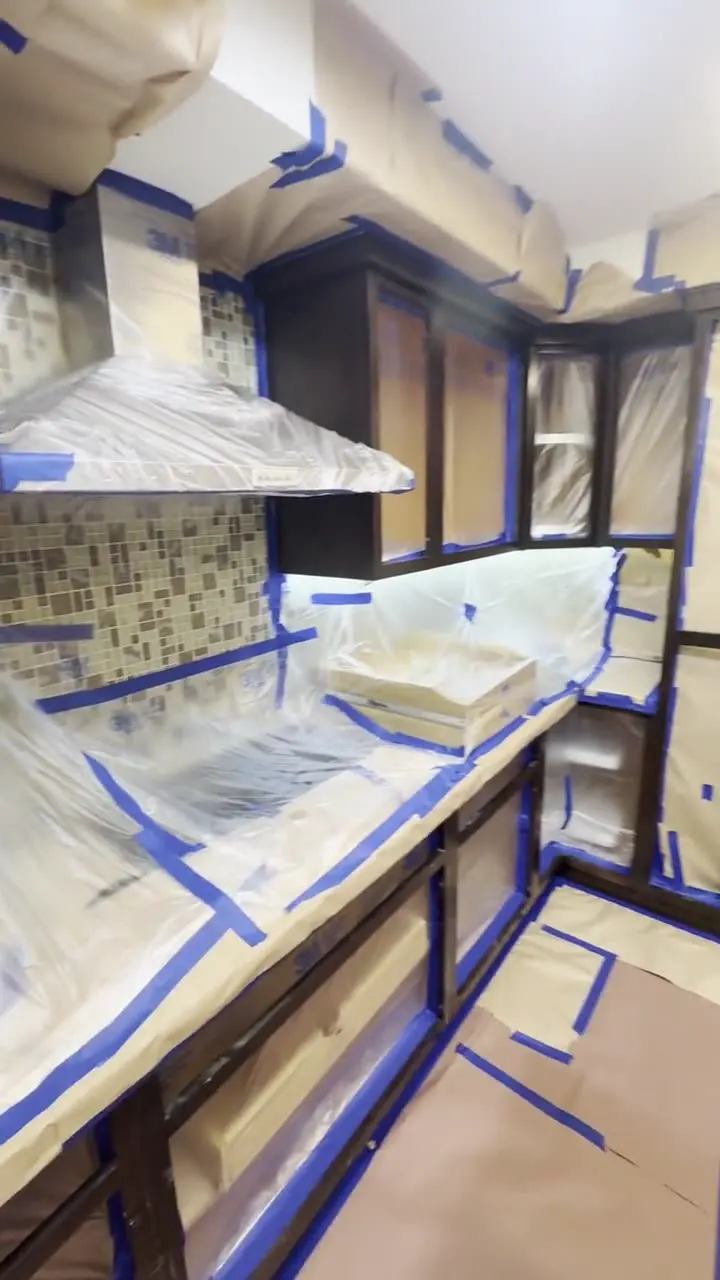
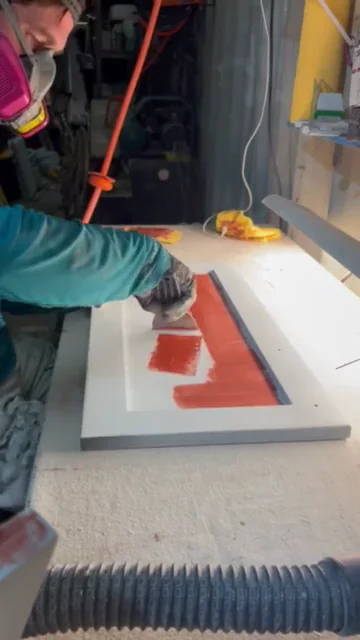
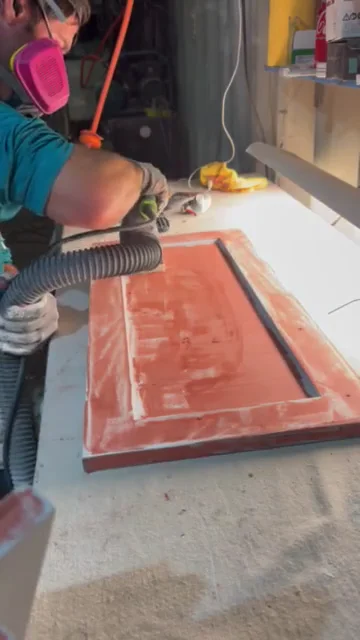
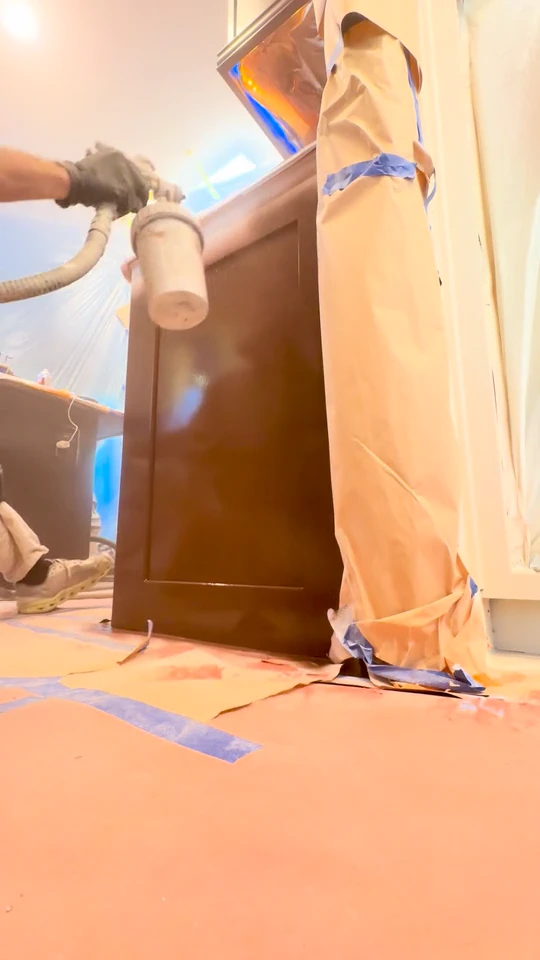
2K polyurethane costs more than one-part cabinet paint. Your quote also covers the preparation, shop finishing and drying time shown here.
Larger kitchens and grain filling take longer; your written quote gives the dates.
Choosing a cabinet refinishing contractor comes down to five checks: where they spray (a negative-pressure booth and a sealed, negative-pressure work area, or a driveway), what coating they use (such as catalyzed 2K), whether the warranty is written, and who will handle the project. Verify the license at cslb.ca.gov before you sign. A fan draws air through a regular filter and vents outdoors to help control airborne dust, overspray, and fumes within the work area.
Where Are the Doors and Drawers Actually Sprayed?
This is the first question to ask, and it separates a controlled cabinet process from an improvised one. Ask directly where the removable doors and drawer fronts are sprayed. A dedicated shop spray booth gives those pieces more environmental control than a driveway, garage, or pop-up tent.
Parallel Painting sprays doors and drawer fronts in a negative-pressure booth at Tyler's shop, and sprays the cabinet boxes inside a sealed, negative-pressure work area in your kitchen. Attached cabinet boxes stay in the kitchen, where Tyler sands them with a HEPA vacuum at the sander and sprays them inside a sealed, negative-pressure work area. If a contractor cannot explain both parts of the process in specific terms, keep asking questions.
Is It Real Catalyzed 2K, or Just Marketing Language?
"Commercial-grade," "professional finish," and "premium coating" are marketing phrases, not chemistry. Real two-component (2K) polyurethane is catalyzed: a hardener is mixed into the base coating shortly before spraying, and the finish cures through an actual chemical reaction rather than simple air-drying. That reaction is what gives a catalyzed finish its hardness and chemical resistance compared to single-component paint.
Ask any contractor claiming "2K" to name the pot life (how long the mixed product stays usable) and to produce the product's current technical data sheet. Parallel Painting's cabinet-finishing process uses a sprayed 2K polyurethane finish — factory-grade, two-component catalyzed — and Tyler can explain the coating system and preparation; compare products using current manufacturer documents. If a contractor cannot answer, or answers with adjectives instead of chemistry, keep asking.
Will They Put the Warranty in Writing — and Sign It?
Review the written warranty before work begins, including the covered failures, exclusions, duration and responsibility for repair materials. Parallel Painting backs every cabinet refinishing project with a written 5-year warranty covering chipping, peeling or blistering caused by faulty preparation.
For a deeper set of warranty-specific questions to bring to any bid, see Parallel Painting's companion guide on cabinet refinishing warranty questions to ask.
Is the Owner Actually on the Job?
Ask who will be present at the inspection, during the work, and at the final walkthrough. Tyler Fowler handles each Parallel Painting project personally, from the initial inspection through the final walkthrough. Melissa handles scheduling and phone calls; homeowners can ask Tyler questions about the work and project progress.
How Do I Verify a CSLB License Myself?
Do not take a license number at face value — verify it. Go to cslb.ca.gov, use the license lookup tool, and enter the number the contractor gave you. Confirm three things: the license status is active, the classification matches the work being quoted, and there is no history of disciplinary action or bond problems. This takes about two minutes and it is the single most reliable check available to any homeowner.
Parallel Painting is CSLB #1015608, licensed and active since 2016. Look it up yourself before you decide — a contractor confident in their standing wants you to check, not avoid it.
A Contractor Who Wants the Hard Questions Is Doing You a Favor
These questions help you compare the spray environment, coating system, written warranty, on-site responsibility and license information in each written quote. Use the framework on Parallel Painting or on anyone else bidding your kitchen.
Parallel Painting serves homeowners in Southwest Riverside County (Temecula, Murrieta, Menifee, Wildomar and Lake Elsinore), nearby Fallbrook and the Coachella Valley. Cabinet refinishing is one of Parallel Painting's two specialties; the other is designer wallpaper installation, handled with the same preparation-first standard and the same willingness to answer hard questions before you sign anything.
Vetting Questions — Answered Straight
What is the fastest way to disqualify a cabinet refinishing contractor?
Ask where the doors and drawers are sprayed and how the attached boxes are handled. A driveway, garage, or pop-up tent gives removable pieces less environmental control than a dedicated shop spray booth. The boxes stay in the kitchen, so the contractor should also explain HEPA-vacuumed sanding and sealed, negative-pressure containment for the in-place work. A fan draws air through a regular filter and vents outdoors to help control airborne dust, overspray, and fumes within the work area.
How do I verify a contractor's CSLB license is real?
Go to cslb.ca.gov, use the license lookup, and enter the license number the contractor gave you. Check three things: the license is active, the classification matches the work being quoted, and there are no outstanding disciplinary actions or bond issues. Parallel Painting is CSLB #1015608, active since 2016 — verify it yourself before you sign anything.
What is the difference between real 2K polyurethane and marketing language?
Real 2K (two-component) polyurethane is catalyzed — a hardener is mixed into the base coating shortly before spraying, and it cures through a chemical reaction, not just air-drying. If a contractor calls their finish '2K' or 'commercial-grade' but cannot describe a mixed hardener, a pot life, or a technical data sheet, ask harder questions. Ask to see the actual product's technical data sheet — a legitimate 2K system has one, and any contractor using it should be able to produce it on request.
Why does it matter whether the owner is on the job?
Ask who will be present for the estimate, preparation, spraying, and final walkthrough, and who will handle questions after the project. Tyler Fowler handles each Parallel Painting project personally, from the estimate through the final walkthrough. Melissa handles scheduling and phone calls; homeowners can ask for Tyler.
What should I ask before choosing a cabinet refinisher?
Ask about booth setup, license status, coating chemistry and warranty terms. Review the written warranty before work begins, including covered failures, exclusions, duration and responsibility for repair materials.
Related Resources
Cabinet Refinishing Warranty Questions to Ask
The specific warranty questions to bring to any bid, and what the answers reveal.
Cabinet Refinishing
Parallel Painting's full cabinet refinishing service — 2K polyurethane, spray booth, 5-year written warranty.
What Is 2K Polyurethane?
The two-component catalyzed coating system explained in plain terms.
Cabinet Refinishing FAQ
Answers to common cabinet refinishing questions — pricing factors, timeline, process.
Compare Cabinet Refinishing Bids
What to verify before accepting any bid.
Designer Wallpaper Installation
Designer wallpaper installation and wall preparation.
Next step
Ready to Ask Parallel Painting the Hard Questions?
Call Tyler. He would rather answer everything up front than have you find out later.